When Your Dog's Brain Is Sparky and Yours Isn’t (and Vice Versa)
 Stephie Guy
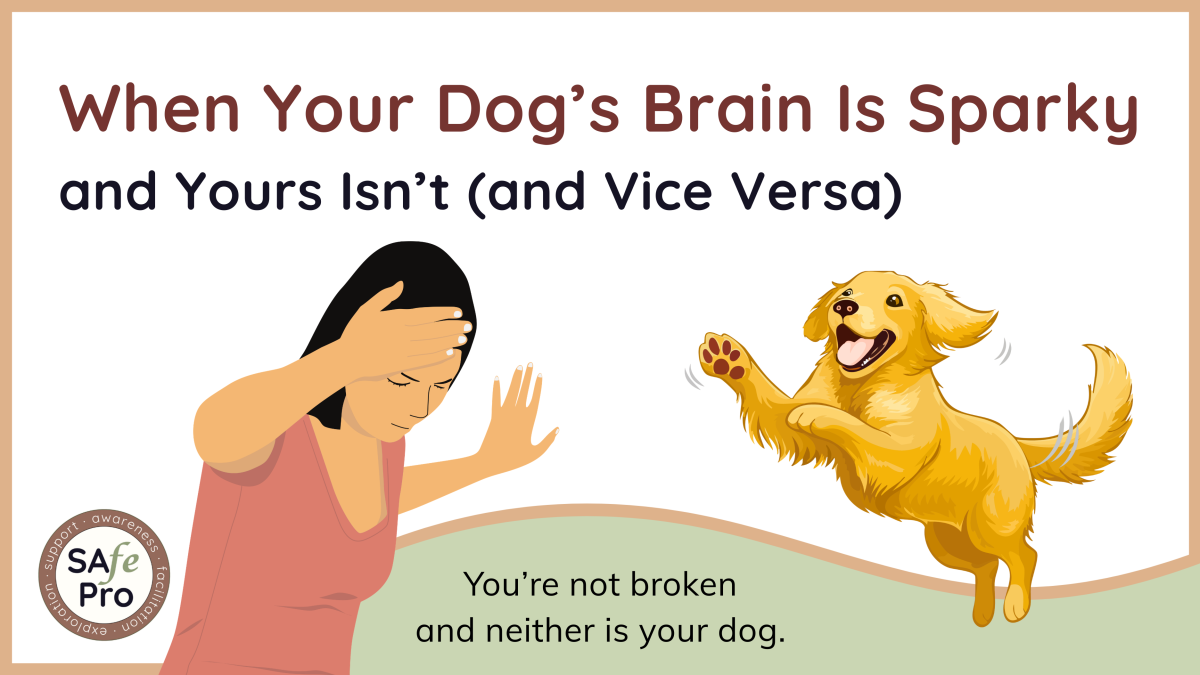
If you’re anything like me, there are times when your brain feels sparky and full of ideas, and other times when it’s like wading through treacle.
There will be some moments where you can think clearly, make decisions, and respond with bouncy joy...and other moments where even small things feel like a huge millstone weighing you down. And (if you're anything like me) you'll find it frustrating when your energetic sparky brain is online while all the other humans' brains in your life are offline. Sometimes it's exhausting trying to organise anything!
It probably won't surprise you to hear that dogs have these rhythms too: there are times when they're more settled and able to take things in, and other times when their listening and processing skills seem to be completely missing.
I think what we're really noticing here is that capacity changes across the day for both species. Sometimes those peaks and dips line up, and sometimes they don’t, and that's not the thing that matters. What matters is paying attention to that ebb and flow so we can support ourselves and our dogs in real time.
Over in the Shouty-Barky Dog Group we explored what feeds into that ebb and flow of capacity, and how it lines up across species.
Time of day
It seems that most of us naturally think more clearly at certain points in the day. Some of us are brighter in the morning, some later on, some only only come to life when everyone else has gone to bed. Dogs show similar patterns. There are moments when they seem more available for connection, teamwork, and problem solving, other times when they're 100% up for a big nap, and other times when it either seems like they're bouncing off the walls or barking at everything.
Sometimes our daily rhythms line up beautifully with our dogs. Sometimes they don’t. And when they don’t, it means one or other of you is being asked to function at a time when your nervous system already feels stretched to breaking point. You might be trying to problem-solve when your brain is tired, or your dog might be expected to be still when their brain is telling their body to move. That doesn’t mean anyone is doing anything wrong. It just tells us the timing is off.
Sensory interruptions
If we think about it, there are hundreds of potential sensory interruptions going on all around us all of the time. Right now, as I write this blog, I'm fidgeting in my chair, my socks aren't comfy, I can hear an aeroplane, Mickle is grooming his paws, I can hear my husband on a call in his home office, my laptop fan is whirring, the birds are singing outside, my coffee smells good, my hair is tickling my face, I'm too hot... and I could go on. It's a lot!
When we explored in the group which sensory interruptions most often get in the way of clear thinking, noise came up the most. That makes sense. Noise takes processing power. It pulls attention outward, and it uses up headspace. Interestingly, for some people a constant background layer, maybe traffic or voices or music, actually helped. One person commented that overstimulation from lots of different noises all at once was difficult to deal with, and as someone who has a hard time filtering out insignificant sounds, I totally understand that.
Dogs experience sensory interruptions too. Sound, movement, visual stimulation, scent, taste, physical discomfort, all of it adds to their internal workload long before we see obvious signs on the outside. So when a dog starts barking, pacing, or struggling to settle, it’s often happening at a moment when their nervous system is already carrying quite a lot.
Those sensory interruptions might be happening at a time of day when sparky brains are offline.
When our body clocks are out of sync and our sensory processing is struggling, it's easy to see why one or both of us might snap.
So what can we do about it?
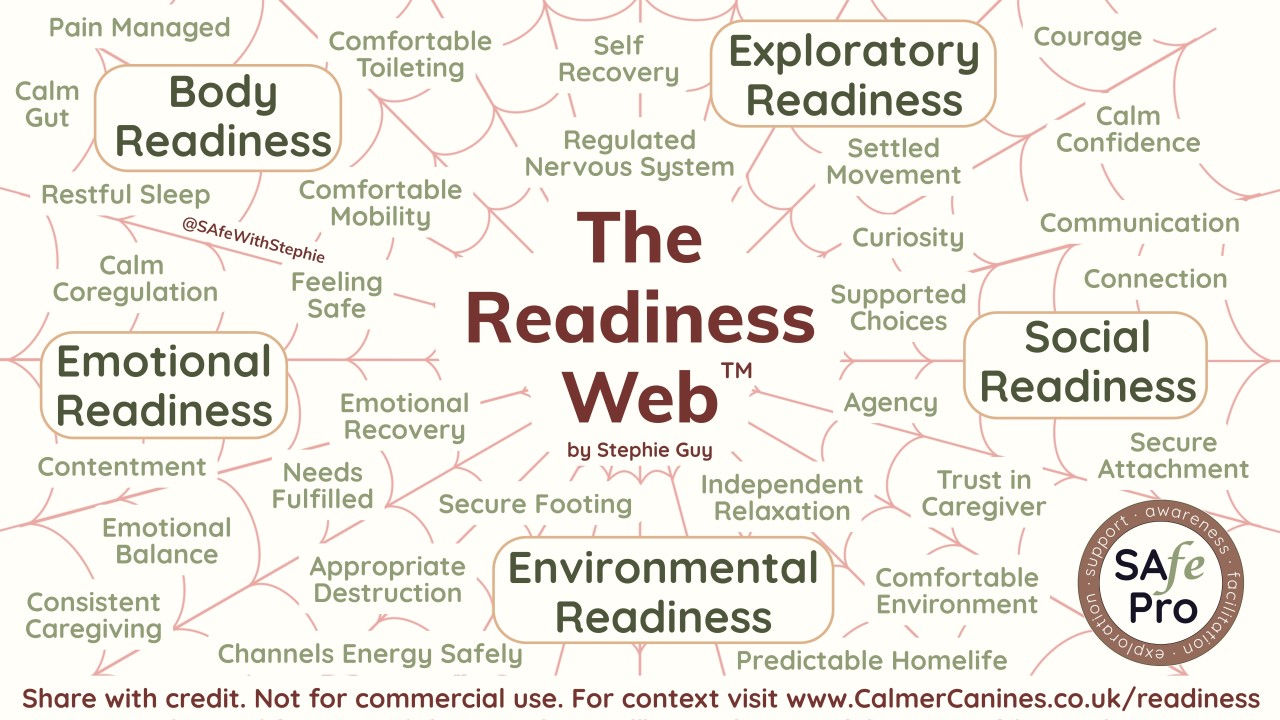
It can help to step back and look at this through the lens of The Readiness Web™.
Readiness isn’t about motivation or willingness. It’s about whether the body, brain, and environment are lined up well enough for tolerance, learning, or problem solving to happen at all. If headspace is already being used up by noise, tiredness, physical discomfort, or emotional load, there simply isn’t much spare capacity available.
If your brain is offline when your dog's is online, try this:
- Notice your own energy patterns, your dog’s patterns, and where sensory interruptions creep in.
- Write it down.
- Think about how you might find more room to manoeuvre. You might change timing, lower background noise, check in with your breathing, pause before responding, or create quieter pockets in the day.
- Make small, realistic adjustments that protect headspace.
Supporting sensitive dogs isn’t just about techniques. It’s about capacity, yours and theirs, and being able to notice, in real time, how much readiness is actually there.
Sharing the Readiness Web™
You’re welcome to share the Readiness Web™ graphic unaltered, as long as you include clear credit to Stephie Guy (@SAfeWithStephie) and link to the full explanation at www.calmercanines.co.uk/readiness. The blog adds the context and nuance needed to use the web as it was intended, so please share them together wherever possible.
The Readiness Web™ is not permitted for use in paid teaching, courses, workshops, or any commercial materials without prior written permission. If you’d like to reference it in professional work, please direct people to the blog rather than including the graphic inside your own content.
For Caregivers
For a deeper dive into this and many other topics, come and be part of the Calmer Canines Club. It’s designed to support both caregivers and professionals with practical ideas, thoughtful discussion, and an extensive resource library.
For Professionals
If you’re a trainer or behaviour professional working with families affected by separation anxiety, the SAfe Pro Course will help you go beyond stopwatch desensitisation and towards true readiness-based support.
You’ll learn to integrate the Readiness Web™, ACE Free Work, and trauma-informed practice into your client work, giving both dogs and caregivers space to rebuild safety, confidence, and trust.
The Shouty-Barky Dog Group
The Shouty-Barky Dog Group is a warm, trauma-informed space for people living or working with anxious and sensitive dogs. Through Stephie’s thoughtful questions, we explore varied themes in depth, giving you time to reflect, discover, and draw your own conclusions without pressure, judgment, or unsolicited advice.