Christmas Isn’t Just Busy, It’s Loud, Bright and Smelly
 Stephie Guy
At Christmas, a dog can look settled while quietly carrying far more than they can cope with. Here's why.
When we think about Christmas being “a lot” for dogs, we usually picture the obvious bits. Extra visitors. Busy walks. Changes to routine.
But for many dogs, especially sensitive ones, the real load comes from something quieter and easier to miss.
Christmas radically changes the sensory environment.
This applies whether you’re celebrating Christmas itself, New Year, or simply living through a season where homes, routines and environments change.
Lights flicker where there were none before. New sounds appear and repeat unpredictably. Smells linger in the air for days. Furniture shifts. Pathways narrow. Even the way we move through the house changes.
From the dog’s point of view, their familiar, predictable world has been redesigned.
Sensory load adds up, even when nothing “happens”
A dog doesn't need to be frightened or reactive for the nervous system to be working harder. Constant low level sensory input keeps the system on alert, even if the dog looks settled.
Christmas often brings:
- Twinkling or flashing lights
- Music, films, laughter and overlapping voices
- Strong food smells, candles and air fresheners
- Crinkling paper, clinking glasses, sudden cheers
- Doors opening more often and at unusual times
Each one on its own may seem insignificant. Together, they increase background vigilance, and this is where behaviour can become misleading. Dogs adapt to overwhelm in different ways. Some may become quieter or more still, others more watchful, restless or reactive. What we’re seeing is not how well a dog is coping, but how their nervous system is managing increased load.
Understanding this through The Readiness Web™
The Readiness Web™ is a way of understanding everything that shapes how a dog copes with life, beyond what we see in behaviour alone. It’s made up of five interconnected strands:
- Body Readiness
- Emotional Readiness
- Environmental Readiness
- Social Readiness and
- Exploratory Readiness.
When the web is well supported, it can flex and absorb change. When strands are already under strain, even small additional pressures, such as increased sensory load at Christmas, can tip the whole system into difficulty.
The graphic helps make this visible. Each strand represents a different area of support, and the spaces between them matter too. A balanced web has room to respond. A web that is already tight or uneven has far less flexibility.
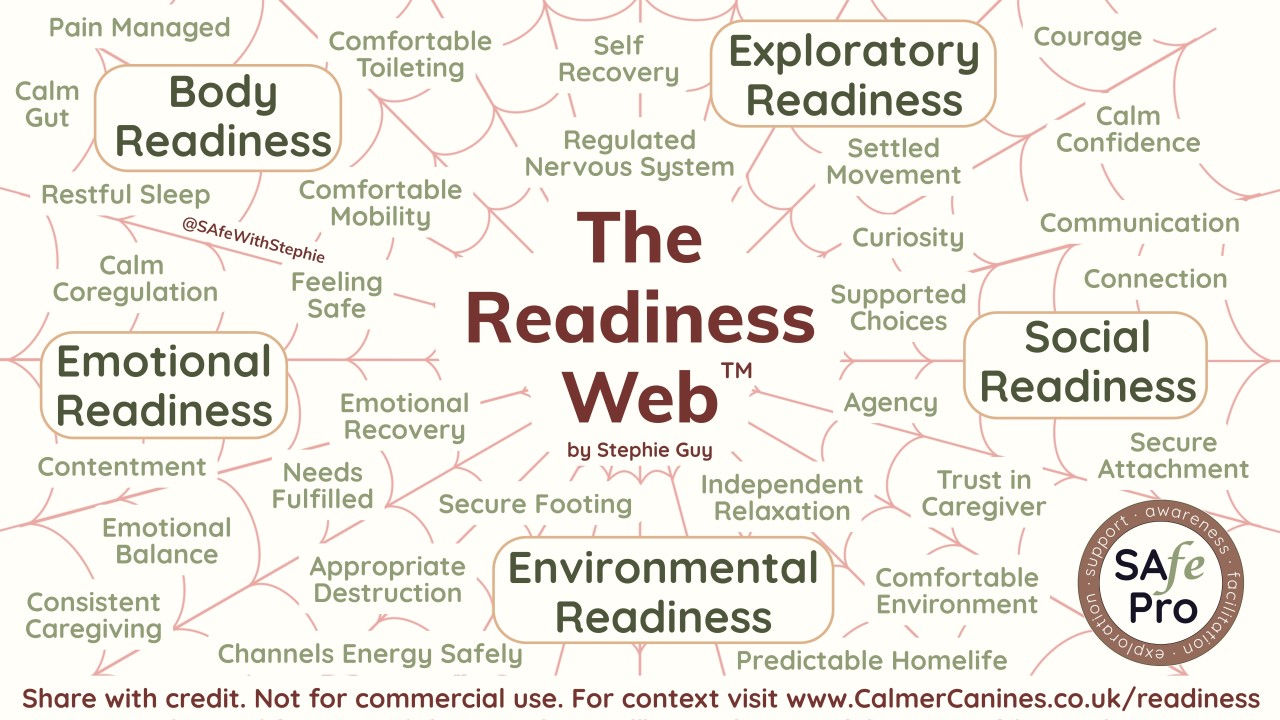
Each strand represents a different area of support. When one strand is stretched, such as environmental or sensory load, the whole web has less room to flex and adapt.
This is why behaviour rarely tells the whole story. The Readiness Web™ reminds us that what we see on the surface sits on top of many underlying influences.
At Christmas, and often across the wider festive season, Environmental Readiness, particularly sensory input, often tightens first. When that happens, capacity in other areas quietly reduces.
And when sensory load increases:
- Recovery takes longer
- Tolerance for social or movement demands reduces
- Small stressors tip more easily into overwhelm
- Regulation becomes harder to access
This can show up later as irritability, restlessness, increased vigilance, clinginess or behaviour changes that feel sudden or out of character.
Nothing new has “gone wrong”. Capacity has quietly been eaten away.
Why familiar dogs can still struggle
Even dogs who have “done Christmas before” can find each year different. Bodies change. Sensitivities shift. Previous coping strategies may no longer be enough.
The Readiness Web™ encourages us to move away from assumptions like “he’s always been fine with this” and towards curiosity about what the dog is experiencing now.
Christmas does not have to be dramatic to be demanding.
Simple support that really helps
Supporting this strand of the Readiness Web™ does not mean removing Christmas. It means assessing its impact.
Small changes matter:
- Turning off decorative lights, especially flashing or colour changing ones, when not needed
- Keeping one area of the house visually and acoustically quiet
- Reducing layered sound, not just volume
- Being mindful of strong or constant scents
- Preserving clear pathways and familiar layouts
These adjustments lower background load so the dog has more capacity for everything else that the season brings.
A quieter foundation supports everything else
When the sensory environment is calmer, dogs are better able to:
- Rest more deeply
- Tolerate social contact
- Cope with changes in routine
- Recover between events
This is why the Readiness Web™ starts long before training or behaviour plans. At Christmas, the environment often does the heaviest lifting, for better or for worse.
You don't need to make the festive season perfect. You just need to make it possible.
Supporting sensory safety is one of the kindest places to start.
Sharing the Readiness Web™
You’re welcome to share the Readiness Web™ graphic unaltered, as long as you include clear credit to Stephie Guy (@SAfeWithStephie) and link to the full explanation at www.calmercanines.co.uk/readiness. The blog adds the context and nuance needed to use the web as it was intended, so please share them together wherever possible.
The Readiness Web™ is not permitted for use in paid teaching, courses, workshops or any commercial materials. If you’d like to reference it in professional work, please direct people to the blog rather than including the graphic inside your own content.
For Caregivers
For a deeper dive into this and many other topics, come and be part of the Calmer Canines Club. It’s designed to support both caregivers and professionals with practical ideas, thoughtful discussion, and an extensive resource library.
For Professionals
If you’re a trainer or behaviour professional working with families affected by separation anxiety, the SAfe Pro Course will help you go beyond stopwatch desensitisation and towards true readiness-based support.
You’ll learn to integrate the Readiness Web™, ACE Free Work, and trauma-informed practice into your client work, giving both dogs and caregivers space to rebuild safety, confidence and trust.
Come and join the next cohort here:
The Shouty-Barky Dog Group
The Shouty-Barky Dog Group is a warm, trauma-informed space for people living or working with anxious and sensitive dogs. Through Stephie’s gentle and thoughtful questions, we explore varied themes in depth, giving you time to reflect, discover, and draw your own conclusions without pressure, judgment or unsolicited advice.