 Stephie Guy
In the first blog of this three part series, we looked at why separation anxiety isn’t really about time. In the second, we explored how the readiness web gives us a fuller picture than any stopwatch can.
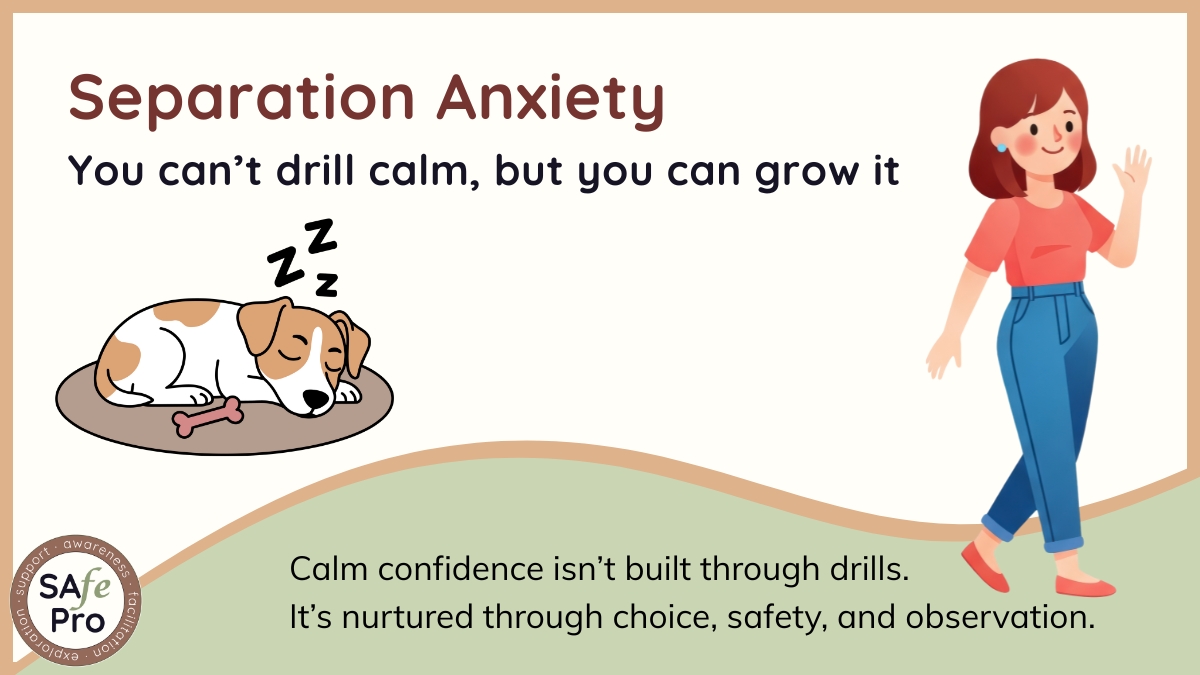
Now, let’s talk about why the old advice of repetition and drills can actually make things worse, and how a different way of working - rooted in ACE principles - helps us build lasting resilience.
When repetition backfires
One of the most common pieces of traditional advice is to pick up your keys over and over until your dog “gets used to it.” Or to open and close the door dozens of times a day until it feels normal.
On the surface, the logic seems sound. Repeat the trigger until it loses its meaning.
But here’s the problem. If your dog already feels anxious at the sound of keys, every repetition simply confirms their fear. “Are you leaving now? What about now? Or now?” Instead of reducing stress, it keeps them on high alert.
The same happens with doors. If your dog isn’t ready, each drill just rehearses the panic. If they are ready, they don’t need the drill in the first place. Readiness isn’t built through repetition. It’s built by strengthening the web.
ACE principles: building from the inside out
This is where Animal Centred Education (ACE) offers such a powerful framework. It’s a way of working that aligns perfectly with the web model, because it starts not with what the dog “should” tolerate, but with how the dog feels.
A few of the principles I come back to again and again are:
- Free Work - creating safe opportunities for gentle exploration and choice. Every decision a dog makes in Free Work, whether to sniff, pause, move closer or move away, is a rehearsal of agency. These micro-choices are the foundation of being able to cope with bigger choices later, like being on their own.
- No Attachment To Outcome (NATO) - taking the pressure off both caregiver and dog. Success is no longer measured in “minutes alone” but in comfort, communication, and confidence. This shift is often a huge relief for families.
- Observation
over instruction - slowing down enough to notice what’s really happening. A reluctance to
settle, stiffness in movement, frantic digging after meals, subtle changes
in breathing. These are the signals that tell us when a strand of the web
needs support.
From harder training to deeper support
When we stop drilling and start observing, everything changes. We see dogs not as training projects, but as whole beings with physical, emotional, and sensory needs. We see caregivers not as “failing” the plan, but as partners in creating a safe, supportive environment.
And instead of pushing harder against distress, we build resilience from the inside out.
Closing the loop
Across this series, we’ve moved from the idea of separation anxiety as a timing problem, to an iceberg, to a web. We’ve looked at why stopwatch drills fail, and how ACE principles help us build something more sustainable.
The message is simple. Success with separation anxiety doesn’t come from harder drills or longer timers. It comes from strengthening the dog’s web of comfort, confidence, and resilience.
When those needs are met, being alone stops being a terrifying test. It becomes something a dog can genuinely cope with, because the foundations are solid.
For Caregivers
For a deeper dive into this and many other topics, come and be part of the Calmer Canines Club. It’s designed to support both caregivers and professionals with practical ideas, thoughtful discussion, and an extensive resource library.