New Year, Same Dog: Rebuilding Readiness One Strand at a Time
 Stephie Guy
January often arrives with a quiet sigh of relief, but many dogs and humans are already tired, carrying the weight of a demanding season.
The decorations come down. The calendar clears. The noise settles. And yet, for many households, something still feels a little flat.
That’s because it’s not just dogs who reach the New Year carrying a lot. Humans do too.
We come out of December tired in our bodies, stretched emotionally, and often with less capacity than usual. Our dogs feel that alongside everything else they’ve been holding. Nothing has gone wrong. Everyone is simply arriving at January with less in the tank.
This is why the New Year does not need to be about change, training plans or fresh starts. It can be about repair.
January is a recovery month, not a reset
There’s a lot of pressure at the start of the year to do more. More structure. More exercise. More progress.
But for many dogs, January is better treated as a pause rather than a push.
After weeks of disrupted routines, sensory load, social demands and emotional spillover, what most dogs need first is not improvement, but space to rebuild capacity.
This is where The Readiness Web™ becomes especially useful.
Using The Readiness Web™ as a check in
The Readiness Web™ helps us step back and look at the whole picture of how a dog is coping. It reminds us that readiness is supported by five interconnected strands.
- Body Readiness
- Emotional Readiness
- Environmental Readiness
- Social Readiness
- Exploratory Readiness
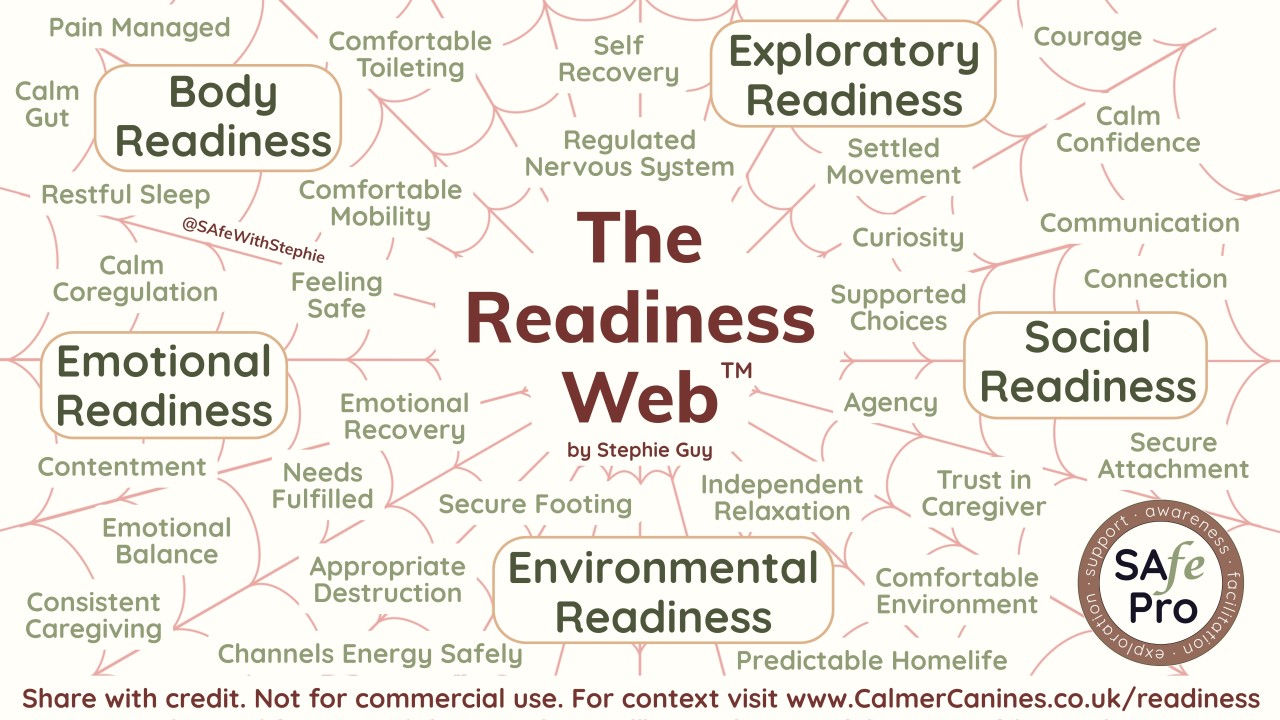
In January, the web does not need fixing. It needs easing.
Rather than asking what you want to work on this year, a more helpful question is often,
Which strand feels most stretched right now, for both of us.
Because dogs do not recover in isolation. They recover alongside the people they live with.
It's enough to choose one strand
One of the kindest things you can do in January is resist the urge to do everything.
You do not need to support all five strands at once. Trying to do so often adds more pressure.
Choose one place to begin. Supporting a single strand often creates more room across the whole web.
Here are some suggestions for how that might look...
Body Readiness, restoring comfort and ease
January bodies are often stiff, slower and less forgiving, human and canine alike.
This might mean warmer resting spots, shorter walks with more sniffing, lower expectations around movement, or simply more time to settle between activities.
Comfort builds capacity.
Environmental Readiness, bringing predictability back
After weeks of change, familiarity matters.
Returning furniture to its usual place, simplifying spaces, reducing background noise and keeping days more predictable all help the nervous system settle.
A calmer environment creates room for recovery.
Emotional Readiness, lowering the bar
Emotional readiness in January is not about enthusiasm or positivity. It is about safety.
Lowering expectations, allowing flat days, and letting emotions move without needing to fix them supports both dogs and humans.
Calm grows where pressure reduces.
Social Readiness, easing connection without demand
After a socially intense season, many dogs need less interaction, not more.
That might look like parallel presence rather than engagement, shared quiet time rather than play, or simply being together without expectation.
Connection does not require activity.
Exploratory Readiness, curiosity at the dog’s pace
Exploration does not need to mean novelty.
It can be revisiting familiar places, slow sniffing, choice led movement or quiet observation. Exploration supports confidence when it happens without rush or expectation.
Curiosity returns when capacity allows.
Progress in January looks quieter than we expect
January progress doesn't have to look like training wins or visible behaviour change.
It can look like longer rest. Easier transitions. Fewer edges. More breathing room.
The Readiness Web™ reminds us that readiness is built through support, not pressure, and that repair is a valid and meaningful form of progress.
You do not need a new dog this year.
You do not need a new plan.
You just need to help the web find its shape again, one strand at a time.
Sharing the Readiness Web™
You’re welcome to share the Readiness Web™ graphic unaltered, as long as you include clear credit to Stephie Guy (@SAfeWithStephie) and link to the full explanation at www.calmercanines.co.uk/readiness. The blog adds the context and nuance needed to use the web as it was intended, so please share them together wherever possible.
The Readiness Web™ is not permitted for use in paid teaching, courses, workshops or any commercial materials. If you’d like to reference it in professional work, please direct people to the blog rather than including the graphic inside your own content.
For Caregivers
For a deeper dive into this and many other topics, come and be part of the Calmer Canines Club. It’s designed to support both caregivers and professionals with practical ideas, thoughtful discussion, and an extensive resource library.
For Professionals
If you’re a trainer or behaviour professional working with families affected by separation anxiety, the SAfe Pro Course will help you go beyond stopwatch desensitisation and towards true readiness-based support.
You’ll learn to integrate the Readiness Web™, ACE Free Work, and trauma-informed practice into your client work, giving both dogs and caregivers space to rebuild safety, confidence and trust.
Come and join the next cohort here:
The Shouty-Barky Dog Group
The Shouty-Barky Dog Group is a warm, trauma-informed space for people living or working with anxious and sensitive dogs. Through Stephie’s gentle and thoughtful questions, we explore varied themes in depth, giving you time to reflect, discover, and draw your own conclusions without pressure, judgment or unsolicited advice.