 Stephie Guy
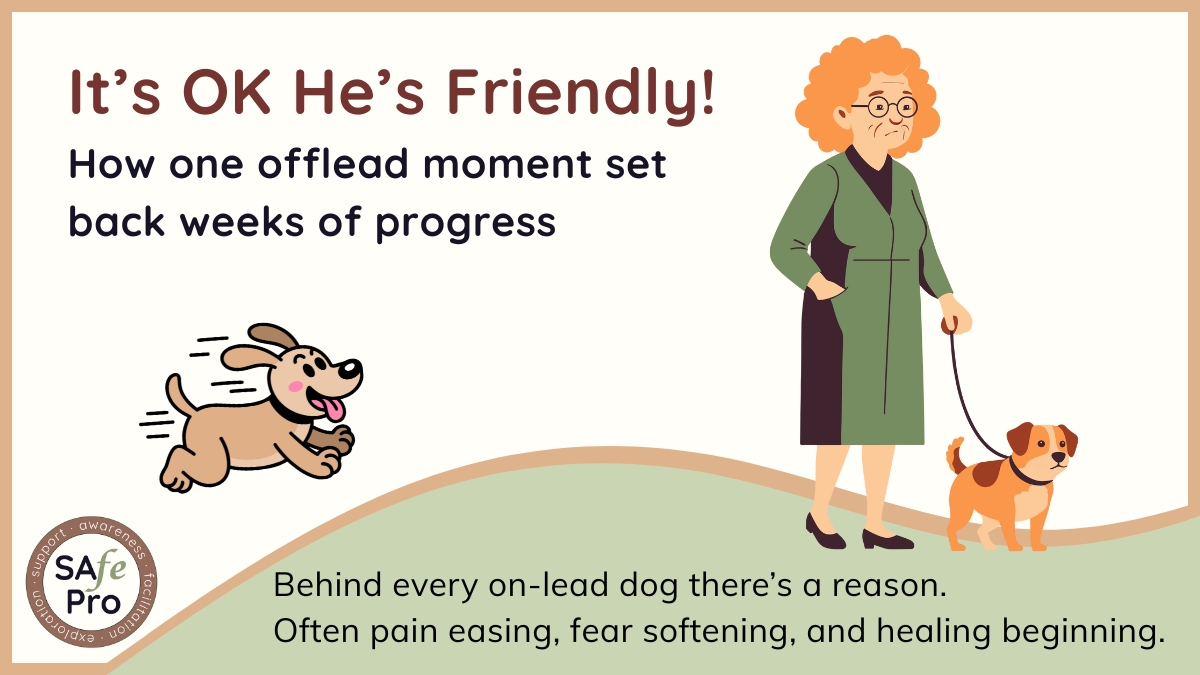
Living With a Dog Recovering From Surgery
I don’t lose my patience very often, but this moment on a dog walk pushed me close.
My dog, Mickle, is recovering from surgery. He has a tendon in his leg that sits in the wrong place and can’t be fixed, so this is something we’ll be managing for life. Since his surgery, he’s been on lead walks only, with weekly hydrotherapy and gentle, structured play to rebuild his strength. It’s slow, careful work, but it’s paying off. The swelling is easing, he’s brighter and more playful, and we’ve even been able to reduce some of his pain relief.
The Day a “Friendly” Dog Ran Over
One morning, after a calm, 40-minute sniffy walk through fields and woodland, we were heading back to the car when a “friendly” off-lead dog spotted us from a distance. Straight away, I changed direction and kept Mickle close, hoping to avoid them without triggering a chase.
But despite our best efforts, the dog came bounding over.
I called out, “Get your dog, mine’s recovering from surgery.”
They ambled closer but didn’t hurry.
Mickle started bouncing around.
A bit louder this time: “Get your dog, mine’s recovering from surgery.”
Still no urgency.
Eventually I shouted, “GET YOUR DOG NOW.”
Their response: “Well I don’t think mine’s doing anything wrong.”
And that’s the part that stung. Their dog might have meant no harm, but the consequences for Mickle were very real. His ankle swelled up. He was sore for days. All that careful progress slipped backwards.
Why Off-Lead Dogs Can Disrupt Recovery
Moments like this affect more than just the physical side of recovery. They ripple through his whole Readiness Web™, the network of comfort, movement, rest, confidence and connection that supports his wellbeing.
Pain changes how he moves, how he sleeps, how he feels in his body and how he relates to the world around him. A single event can cause his whole system to tighten and throw his body and emotions out of balance.
When Our Dogs’ Struggles Affect Our Own Lives
It didn’t just affect Mickle. It affected my own Readiness Web™ as well.
When Mickle is sore, when his Readiness Web™ is in tatters, I can’t leave him because he's not ready - not even for something simple like going to the gym or popping to the shops. The extra worry and disruption mean less rest, less balance and more energy spent keeping things steady for both of us.
It’s a powerful reminder of how interconnected our lives are, and how easily our own webs tighten when our dogs can’t be left.
How to Help: Give On-Lead Dogs Space
This isn’t about blame, it’s about awareness. A “friendly” off-lead dog can cause harm, even when no one means for it to happen.
When you see a dog on lead, please give them space. You never know what they’re managing.
Understanding The Readiness Web™
And if you’d like to understand more about the Readiness Web™, and how pain, emotion, environment and connection all interlink, you can explore it further in my free masterclass replay:
👉 Watch Separation Anxiety Unpacked
Seeing Mickle in pain again reminded me that recovery isn’t a straight line, no matter how much care we put in. It brought me back to the heart of what The Readiness Web™ represents, how every strand connects, and how our dogs’ webs and our own are woven together.
When one of us is unsettled, the other feels it too. So we slow down, rebalance and rebuild. That’s what healing really looks like when we see it as a shared process.
For Caregivers
For a deeper dive into this and many other topics, come and be part of the Calmer Canines Club. It’s designed to support both caregivers and professionals with practical ideas, thoughtful discussion, and an extensive resource library.