When Separation Anxiety Looks Like Aggression
 Stephie Guy

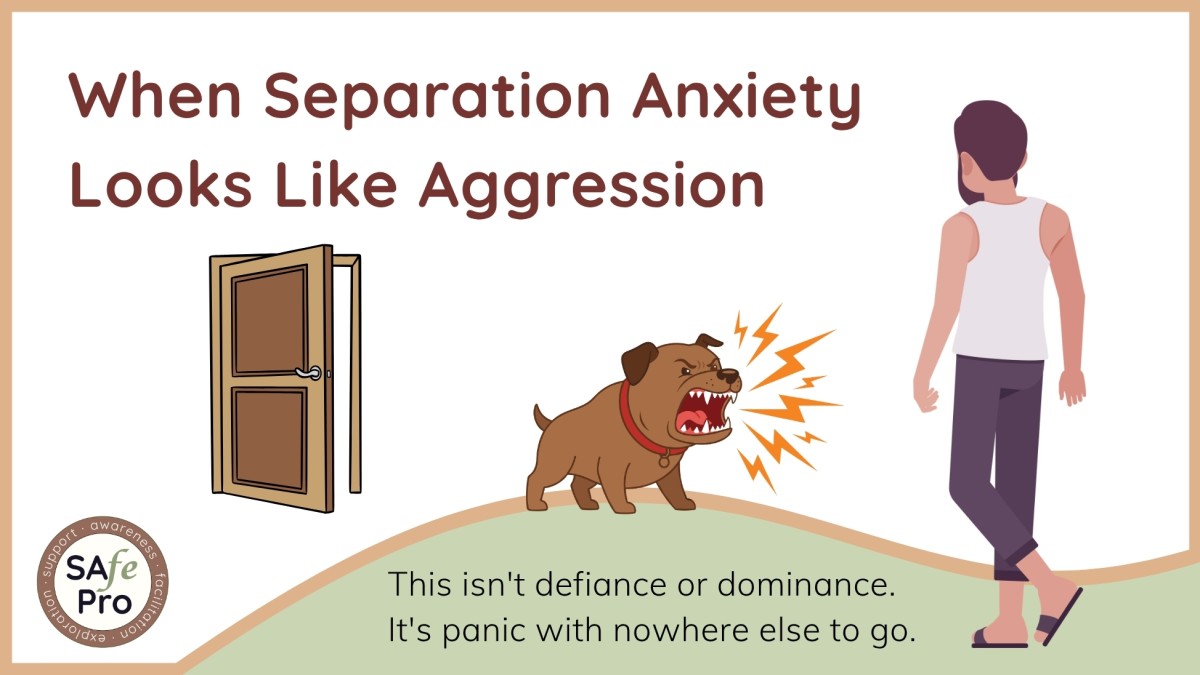
I was tagged in a post on facebook from someone whose dog has started reacting with aggression whenever they try to leave a room. Barking, growling, lunging, grabbing at feet and clothes, and every time it happens, the response feels more intense than the last.
Reading through it, my first thought was pain. Barking, lunging and growling when someone moves can be related to pain, especially if it feels like the dog is trying to stop the person from moving at all. Movement causes bracing, and bracing exacerbates pain, so that's always worth ruling out with a vet and a physical/physiotherapist before anything else.
But it also got me thinking about a different, similar looking picture I sometimes see. So for a moment, let's set pain aside completely and look at a dog whose story is otherwise the same, but where panic without pain, is driving everything.
This dog settles happily with a chew or a toy as long as his caregiver stays in the room. The moment they show signs of leaving, everything changes: barking, lunging, grabbing at feet and clothes...and it becomes a little more intense every time. He's in good physical health, his gait and movement patterns are well balanced, he has no touch or sound sensitivities. What sets him off is specific: closing a phone case, putting down a book, motion towards the door. And a crate that was meant to be a safe space seems to have gone badly for him at some point, since he won't go anywhere near one now, even with food inside.
In this case, the barking and the lunging are purely about stopping the person leaving. They're not defiance or dominance, they're communication. They're the loudest tool left in the box once every quieter way of saying 'please don't go' has already gone unheard. It gets called aggression because that's what it looks like from the outside. But when you look at what's actually happening, it's a dog whose whole system has decided that being left, even for a moment, is not survivable.
And it can be so confusing for the caregivers. Dogs like this are often affectionate, smart, food motivated, brilliant at training. None of that goes away when the phone is put away or the book put down. What changes is that a signal the dog has learned to associate with being left arrives, and the whole picture shifts from safe to unsafe in a heartbeat.
Why the escalation happens
Every time a caregiver manages to get out of the door despite the protest, the dog doesn't learn that leaving is fine. The dog learns that the smaller signals didn't work last time, so this time needs to be bigger. That's why it keeps escalating. It isn't that they're getting worse at being alone. It's that they're discovering that the quieter ways of saying 'please don't go' get overridden, so the only thing left to try is louder.
The Readiness Web™ view

Separation anxiety that shows up as intensely as this is never about the door on its own. It's much much deeper. Let me share a few examples:
Environmentally, a designated safe space that's been poisoned by a previous experience isn't a safe space at all, whatever's inside it now.
Socially, the whole relationship has organised itself around whether the caregiver is staying nearby, which tells us how much this dog's felt safety depends on proximity.
Exploratorily, a dog who'll play and chew happily as long as someone's in the room, but goes flat the second they're not, has an ability to explore that's entirely conditional on feeling secure, not a lack of interest in toys or food.
Emotionally, this is a dog in a near constant state of high alert, bracing for the next departure cue.
And on the Body strand, even a dog who's physically fit and well isn't exempt. Emotion and physical health run through the same system, so a body that's rarely able to fully relax carries tension of its own, whether or not there's an injury or illness behind it.
None of these can be taken in isolation. They all feed the same nervous system, and that's why trying to solve it at the door, with muzzles or better timing or higher value treats, isn't going to help.
If this is where you are
If your dog's separation anxiety has moved into territory like this, please don't try to manage it alone with videos and advice from a group, as well meaning as that is. A dog this distressed needs behaviourally savvy veterinary professionals involved to fully rule pain in or out, alongside a suitably qualified behaviour professional.
What you can do while you find support
This isn't something to solve alone, but there are things that can make the days before your appointment safer and calmer.
- Where you can, stop rehearsing the exact departure that sets him off, even if that means changing your routine for a while. Every repeat teaches him to escalate further.
- Keep a simple note of what happens before each outburst, the cue, the timing, what he does. It'll help whoever assesses him build a real picture fast.
- Book both a vet and a physical/physiotherapist appointment to rule pain in or out, even if you're fairly sure it isn't that.
- Put the crate away for now rather than keep trying it. A space that's already been poisoned needs a different approach, not more exposure to it.
- Reach out for a professional assessment sooner rather than later. The pattern you're describing tends to get harder to shift the longer it runs. You can find a SAfe Pro here: www.calmercanines.co.uk/find-a-safe-pro
There's real support for dogs like this, and it starts with looking at the whole animal, not just the moment at the door.
Stephie 🐾
Separation Anxiety & Sensitive Dog Specialist | Founder of SAfe