Separation Anxiety Doesn't Start At The Door
 Stephie Guy
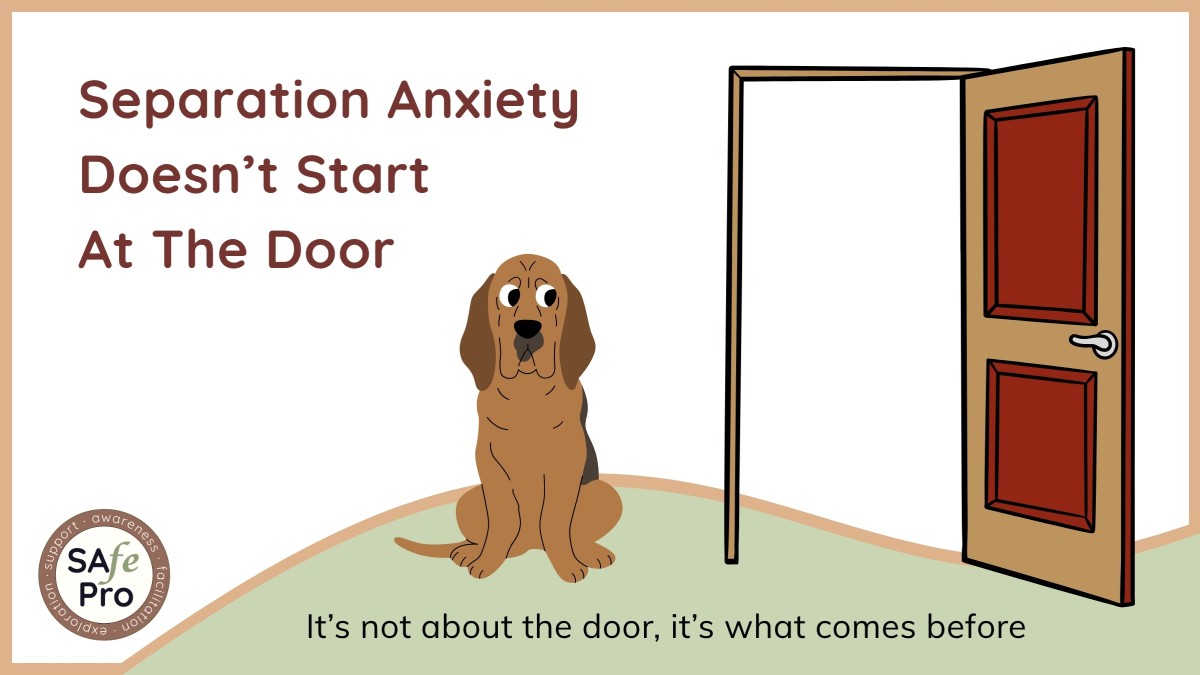
Part 1 of the SAfe Separation Anxiety Series
When people reach out about separation anxiety, the conversation often begins in the same place; it centres around the moment of leaving.
What happens when the keys are picked up, when the coat goes on, when the door closes, how long the dog can manage before they begin to unravel. It’s the part that is most visible, the part that interrupts daily life, and the part that understandably feels most urgent to change.
Because of that, most approaches focus there too; short absences, gradual increases, careful monitoring, trying to stay just under the point where everything tips over. Sometimes that brings a sense of progress, at least for a while, but just as often it feels fragile; like you’re putting in a lot of effort without anything really working.
Where our attention usually goes
When everything seems to fall apart at the point of leaving, it’s easy to assume that this is where the problem begins. The barking starts when you leave. The pacing starts when you leave. The distress shows up when you leave.
So it makes sense that all of the attention goes there. But when you step back and look a little more closely, a different picture often starts to emerge.
What’s happening before that moment
What I’m more interested in is what the dog’s day feels like when nothing much is happening; not the obvious reactions, but the quieter, in-between moments that are easy to miss. How the dog moves around their home, whether they can settle into rest or remain slightly on edge, how they respond to small changes like a person standing up or moving into another room, whether they seem to know what to do with themselves or whether they're constantly orienting towards the person, waiting, hovering, checking.
In many of the dogs I see, those moments carry a quiet kind of effort; nothing dramatic, nothing that immediately signals a problem, but a very real sense that things are not entirely OK.
The leaving is where it becomes visible
When the person is present, those small pressures are often manageable; there's enough support, enough familiarity, enough predictability to keep things within a workable range.
But when the person leaves, that support is no longer there, and what was manageable becomes much harder to hold together. The behaviour shows up at that point, but it hasn’t been created there; it's simply become visible.
Why this can feel so frustrating
This is why focusing only on the act of leaving can feel as though it never quite reaches the heart of what is happening. You can follow everything carefully, take it step by step, do exactly what has been suggested, and still feel as though something isn’t shifting in a lasting way. Not because anything has been done incorrectly, but because the focus has been on the final layer, rather than everything that sits underneath it.
Looking somewhere different
Instead of starting with how long the dog can be left, it can be more useful to start with how the dog is living. Where things feel free and easy; where they feel effortful; where there's room for choice; and where there isn’t.
As those areas begin to change, you often see a shift that isn’t directly linked to any practice around leaving at all. Movement becomes more fluid, rest becomes more accessible, small decisions become clearer and easier to make.
And that changes what being alone feels like, because it is no longer sitting on top of everything else.
If your dog struggles to be alone, try this:
👉 Spend a day noticing the dog in the ordinary moments, rather than the big reactions.
👉 Watch how they move around the house, how they settle, what happens when you stand up or move into another room, where things appear smooth and where they seem just slightly more effortful.
👉 Write it down. You can use a journal, or scraps of paper, or your phone's notes app, it really doesn't matter how you record it - what matters here is that you're making an effort to notice.
There's nothing to change yet; the value is in seeing it more clearly.
If this has got you thinking…
The next blog looks at why “they’re fine when I leave” doesn’t always tell the full story, and what might be happening instead.
Read it here: https://www.calmercanines.co.uk/blog/dog-is-fine-alone-but-not-in-next-room
Stephie 🐾
Separation Anxiety & Sensitive Dog Specialist | Founder of SAfe
Sharing the Readiness Web™
You’re welcome to share the Readiness Web™ graphic unaltered, as long as you include clear credit to Stephie Guy (@SAfeWithStephie) and link to the full explanation at www.calmercanines.co.uk/readiness . The blog adds the context and nuance needed to use the web as it was intended, so please share them together.
For Caregivers
For a deeper dive into this and many other topics, come and be part of the Calmer Canines Club. It’s designed to support both caregivers and professionals with practical ideas, thoughtful discussion, and an extensive resource library.
For Professionals
If you’re a trainer or behaviour professional working with families affected by separation anxiety, the SAfe Pro Course will help you go beyond stopwatch desensitisation and towards true readiness-based support.
You’ll learn to integrate the Readiness Web™, ACE Free Work, and trauma-informed practice into your client work, giving both dogs and caregivers space to rebuild safety, confidence, and trust.
The Shouty-Barky Dog Group
The Shouty-Barky Dog Group is a warm, trauma-informed space for people living or working with anxious and sensitive dogs. Through Stephie’s thoughtful questions, we explore varied themes in depth, giving you time to reflect, discover, and draw your own conclusions without pressure, judgment, or unsolicited advice.