The Dog Who Won't Eat Breakfast But Empties The Bowl By Two
 Stephie Guy
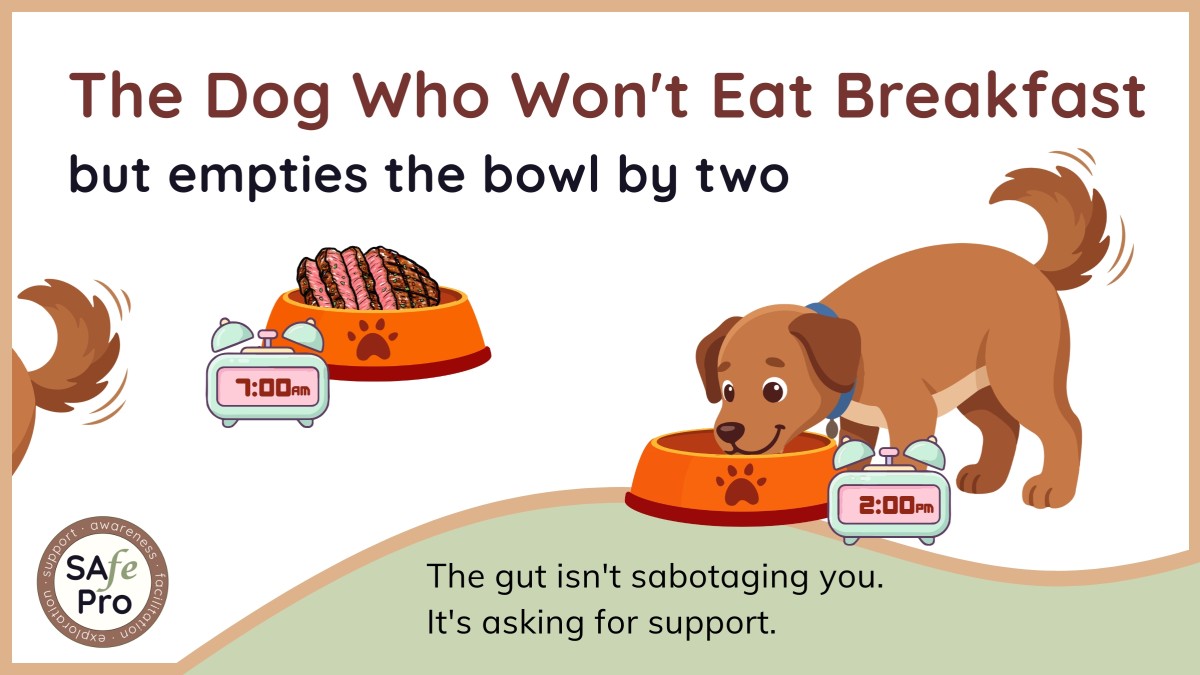
If you've got a dog who turns their nose up at breakfast but is ravenous by mid afternoon, it's easy to read that as fussiness. It usually isn't. It's cortisol, and it's one of the things I learnt from Clinical Animal Behaviourist and Canine Nutritionist Alyssa Ralph during a recent SAfe Pro session on the gut and the microbiome. Where that pattern comes from can tell you something useful about what's going on underneath.
Alyssa told us that in a dog whose system is settled, cortisol peaks about half an hour after waking, then gradually drops off through the day. That morning peak is part of what gets appetite going. But in a dog whose gut isn't in a good state, that peak can shift, sometimes as late as mid afternoon, and appetite shifts along with it. The breakfast bowl sits untouched not because the dog is being difficult, but because their body genuinely isn't ready for food yet.
This is one small, visible example of something much bigger: the gut and the nervous system are in constant conversation, and when that conversation goes wrong, it shows up in behaviour as often as it shows up in digestion.
The gut-brain connection
The gut is home to the microbiome, a community of bacteria, viruses, fungi and other microorganisms living in the digestive tract. It's the largest and most diverse microbiome in the body, and it communicates with the brain along what's called the gut-brain axis, through the vagus nerve, the immune system, the stress response, and the barriers that separate blood from brain.
When that community falls out of balance (a state called dysbiosis) the effects ripple outward. Inflammation in the gut can lead to inflammation in the nervous system. The barriers that are meant to keep harmful substances out become more permeable. Pain sensitivity increases. And the stress response itself becomes less predictable, so a dog is slower to settle after something has unsettled them, or reacts more strongly than the situation seems to call for.
None of this is fringe theory. Alyssa shared a study* where researchers swapped gut microbiota between two mouse strains, one naturally more anxious, one naturally more exploratory. Give the anxious strain's microbiota to the exploratory mice, and they became more anxious. Give the exploratory strain's microbiota the other way, and the anxious mice became more exploratory. Brain-derived neurotrophic factor, a protein tied to emotional regulation, shifted right along with the behaviour in both directions.
The dog research is still catching up to the mouse research, but a recent study using validated behaviour questionnaires alongside gut testing found the microbiome could predict anxious presentations in dogs with 87% accuracy.
Why this matters for separation anxiety
Chronic stress and dysbiosis tend to travel together, each one making the other worse. A dog under sustained stress is more likely to develop an imbalanced gut, and a dog with an imbalanced gut is less resilient under stress. For a dog struggling with being left alone, that means the gut is rarely just a side issue. It's often part of what's keeping the nervous system on edge in the first place.
This is exactly why the gut sits alongside everything else in the Readiness Web™, rather than as something separate from it.

The gut isn't the whole picture on its own, and treating it in isolation, without also addressing environment, safety, and the dog's broader emotional experience, tends not to hold. But leave it out of the picture entirely, and progress made elsewhere can be much harder to sustain. It's exactly this kind of connected thinking, across the gut, the nervous system and the dog's whole emotional world, that sits at the heart of SAfe.
A word of caution on testing and probiotics
It's tempting to reach for a general probiotic the moment gut health comes up, especially with so many multi-strain products marketed for exactly this. But Alyssa told us that a probiotic added on top of an existing overgrowth can make things worse rather than better, since it's feeding a population that's already out of balance. The same caution applies to microbiome testing itself. It's a snapshot, easily skewed by recent scavenging or medication, so it's worth trying the foundational support first and giving it several weeks before testing becomes the next useful step.
What might help
Without needing to test anything, Alyssa told us that there's a lot that supports gut health indirectly:
- Omega-3 fatty acids, for their anti-inflammatory effect
- Polyphenol-rich vegetables, such as broccoli, cauliflower or blueberries
- Prebiotic fibres, which feed the beneficial bacteria already present
- Fermented foods like unsweetened kefir, in modest amounts
- Proper sleep, appropriate exercise, and exposure to varied environments
None of these are dramatic changes, and none of them work in isolation either. But they sit quietly underneath everything else, and a dog whose gut is properly supported tends to have more capacity for everything else you're building together.
If you'd like to go deeper on the gut and nutrition side specifically, Alyssa Ralph works with dogs and their people through her consultancy Holistic Pet Services: www.holisticpetservices.co.uk
And if you'd like to learn more about how SAfe brings Separation Anxiety, the gut, the nervous system and the rest of the picture together, you can read more here: www.calmercanines.co.uk/safe-support
Stephie 🐾
Separation Anxiety & Sensitive Dog Specialist | Founder of SAfe
*If you'd like to dive into the research, this is the microbiota transplant study Alyssa talked us through:
Bercik, Premysl et al. “The intestinal microbiota affect central levels of brain-derived neurotropic factor and behavior in mice.” Gastroenterology vol. 141,2 (2011): 599-609, 609.e1-3. doi:10.1053/j.gastro.2011.04.052 https://pubmed.ncbi.nlm.nih.gov/21683077/