When the Words Don’t Mean What We Think They Mean
 Stephie Guy
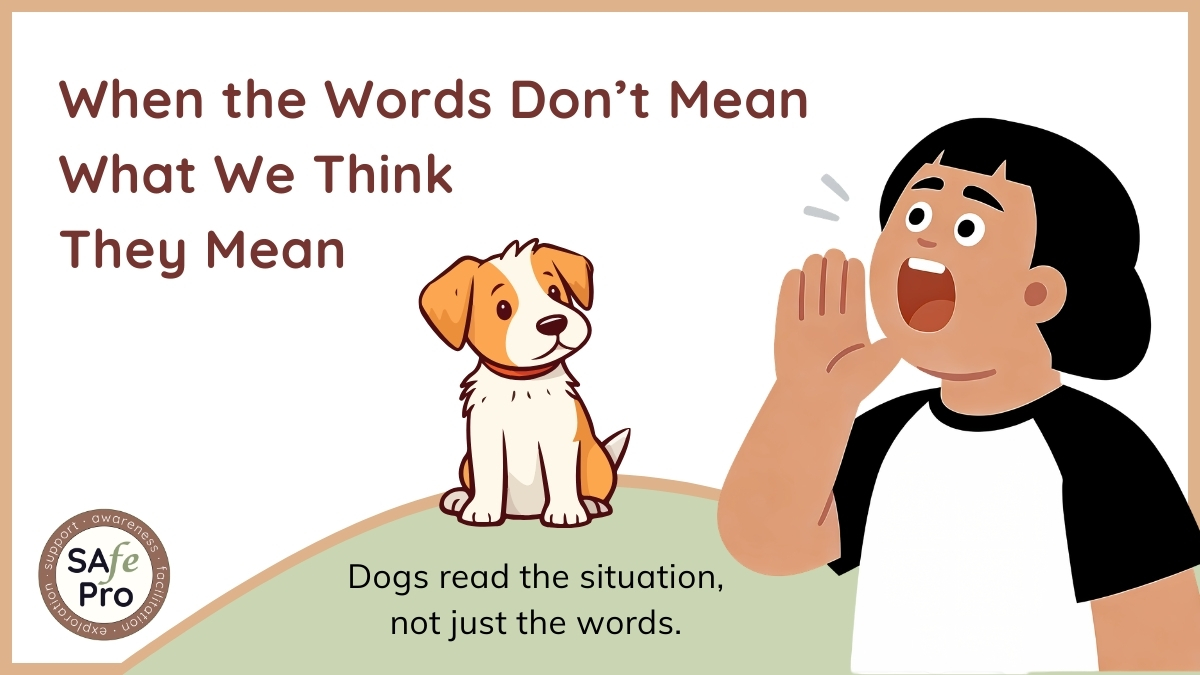
When you live with an anxious dog, it’s completely natural to want to prepare them for difficult moments.
Caregivers often start thinking about the words they might need in those situations. “Leave it.” “This way.” “Call your dog.” “It’s OK.” The idea is that if the dog hears those words often enough, they will begin to feel calmer when the situation happens for real.
It’s a very understandable instinct. But words on their own rarely carry the meaning we think they do. Meaning comes from the situation around them.
We All Learn Through Patterns
Think about the human experience for a moment. We don’t really learn the meaning of words in isolation; we learn patterns.
Imagine someone standing in the middle of an empty field suddenly shouting, “Watch out for the bike!” If there are no cyclists anywhere nearby, the words feel odd. Your brain immediately starts scanning the environment, looking for the missing pieces. Where is the bike? Who are they warning? What situation have I stepped into? The words alone don’t make much sense without the situation that normally goes with them.
Our nervous systems are constantly linking signals with the wider picture around them. Dogs do exactly the same thing.
Dogs Read the Whole Picture
For most dogs, the words themselves are only a small part of the information they are using. The environment, movement, body language and emotional tone all combine to tell the dog what is actually happening. When those pieces don’t match, the dog can become more uncertain rather than less.
Put yourself back into that empty field, and this time you are standing there with your dog beside you. You start calling out, “Watch out for the bike!” even though there are no cyclists anywhere nearby. Your dog hears the change in your voice and immediately begins scanning the environment. In his experience those words usually appear when something fast and potentially worrying is about to pass. His body prepares for something that hasn’t happened yet. But there is no bike.
The words arrive, but the rest of the pattern is missing. Instead of learning that those words predict safety, the dog may simply become more alert, trying to solve a puzzle that doesn’t make sense. Dogs are extremely good at noticing these mismatches.
An Example From Mickle
I see many versions of this with my own dog, Mickle. Here's one of them...
If I say “hello” or “hi” while I am on the phone at my desk, he doesn’t react at all. That sound belongs to phone conversations and means nothing to him.
But if I say “hello” while I'm in the kitchen, he jumps up immediately and starts scanning the room, checking the hallway and looking towards the windows. In his experience those words mean that a person has appeared somewhere nearby.
If I tried to change his response to this by wandering around the house randomly saying “hello” when nobody was there, Mickle would almost certainly become more alert rather than less. His brain would register that something in the pattern had changed, because the word that normally predicts a person would now appear with no person at all.
Rather than learning that the word is safe, he would be trying to solve a puzzle that no longer makes sense.
Why This Matters for Anxious Dogs
For anxious dogs this matters even more, because their nervous systems are already working hard to scan the environment and predict what might happen next. When we add signals that normally belong to a meaningful situation but remove the situation itself, the brain can struggle to file that information anywhere useful.
Words do matter. They can become very helpful signals for dogs when they consistently appear alongside experiences the dog understands. The words make the most sense when they appear inside the full picture the dog already recognises.
If we want a dog to feel safer around other dogs, the learning often needs to happen with another dog somewhere in the environment, whilst being emotionally far enough away that the situation still feels manageable. If we want a dog to feel safer around noise, the sound needs to be present at a level the dog can process.
When the pieces line up, the environment, the words and the dog’s experience all tell the same story. The nervous system then has a much easier job of learning from it.
Try This
If you’re working with an anxious dog, it can help to think about practising the situation, not just the words.
- Practise with the real trigger present, but at a distance where your dog can still think and stay connected to you.
- Use the words when the environment matches the situation they normally belong to.
- Notice what your dog does when they hear the words. Are they scanning the environment or relaxing into the moment?
- When you do use phrases like this, try a “one and done” approach. Say them once, clearly and calmly, then focus on what your dog does next.
- Start small. A brief glimpse of another dog at a distance can be far more useful than repeating phrases in an empty space.
If these steps are too much for your dog, break the trigger down into its sensory elements and use ACE Free Work to process them (if you need help with this, check out The Calmer Canines Club).
Sometimes the most useful practice isn’t repeating the words. It’s arranging the situation so the whole pattern makes sense to the dog.
Why This Matters for Dogs With Separation Anxiety
You might be wondering what this has to do with separation anxiety.
If a dog cannot find steadiness when something appears unexpectedly outside the home, for example another dog, a cyclist, or a person approaching, that tells us something about the nervous system’s current level of readiness.
Readiness outside the home and readiness inside the home are often connected. A dog who is frequently pushed into alert scanning, bracing, or problem-solving in the outside world may arrive back home carrying that load in their system. And a nervous system that is already working hard is much less likely to feel ready for a person to disappear behind a closed door.
In the SAfe programme, we spend a lot of time looking at this wider picture of readiness using The Readiness Web™. Rather than focusing only on the moment of departure, we explore how experiences across the dog’s whole day influence whether the nervous system is ready for being left.
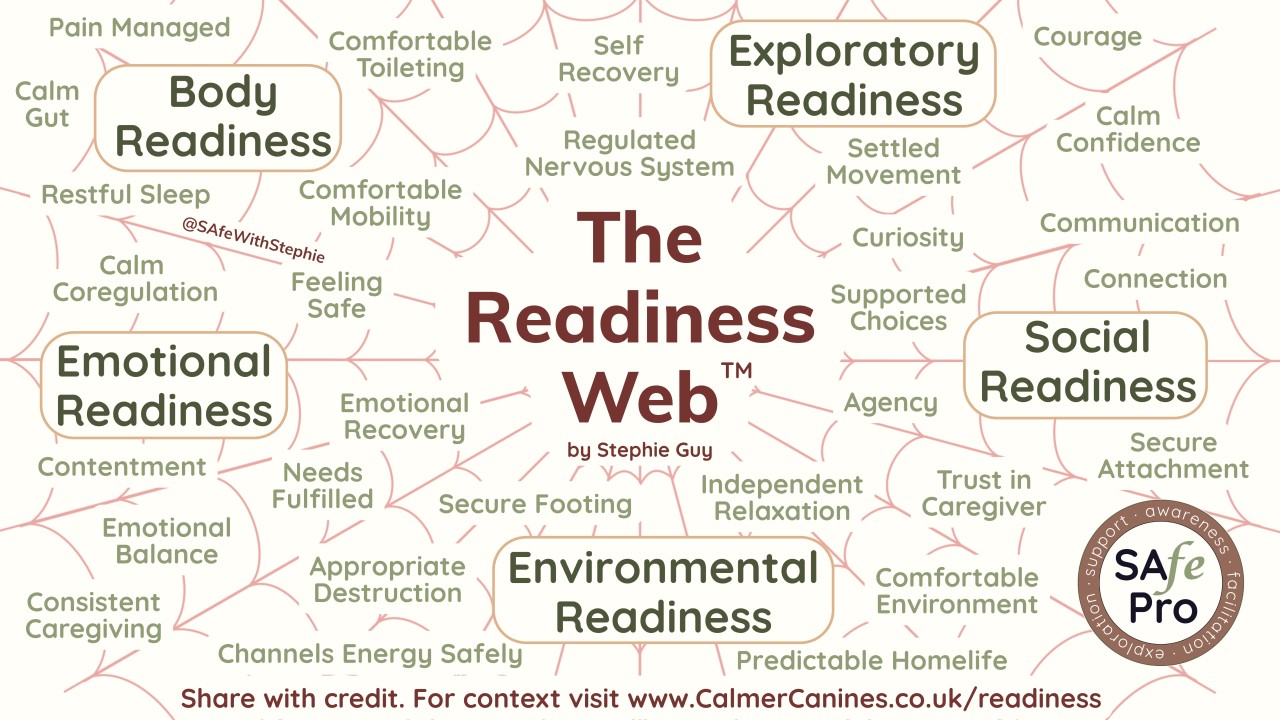
When readiness grows in the outside world, it grows inside the home as well.
Sharing the Readiness Web™
You’re welcome to share the Readiness Web™ graphic unaltered, as long as you include clear credit to Stephie Guy (@SAfeWithStephie) and link to the full explanation at www.calmercanines.co.uk/readiness . The blog adds the context and nuance needed to use the web as it was intended, so please share them together.
For Caregivers
For a deeper dive into this and many other topics, come and be part of the Calmer Canines Club. It’s designed to support both caregivers and professionals with practical ideas, thoughtful discussion, and an extensive resource library.
For Professionals
If you’re a trainer or behaviour professional working with families affected by separation anxiety, the SAfe Pro Course will help you go beyond stopwatch desensitisation and towards true readiness-based support.
You’ll learn to integrate the Readiness Web™, ACE Free Work, and trauma-informed practice into your client work, giving both dogs and caregivers space to rebuild safety, confidence, and trust.
The Shouty-Barky Dog Group
The Shouty-Barky Dog Group is a warm, trauma-informed space for people living or working with anxious and sensitive dogs. Through Stephie’s thoughtful questions, we explore varied themes in depth, giving you time to reflect, discover, and draw your own conclusions without pressure, judgment, or unsolicited advice.