 Stephie Guy
When people see me walking Mickle on a fabric martingale collar rather than a harness, many assume I have missed something. Trainers and behaviourists often expect harnesses to be the default choice for comfort and freedom of movement. I teach that too. Yet for Mickle, a harness is not the supportive choice it might appear to be.
Mickle is a deeply body sensitive dog. He has fatty lumps throughout his body, including some that have infiltrated muscle. He also has hip dysplasia and tendon issues in his left hock, which means he protects that leg by loading more weight through his forelimbs. His shoulders work far harder than they should, and he is frequently tender across that area.
Add these layers of discomfort together and pressure on his torso does not feel neutral. A harness that would feel fine to many dogs adds sensation and strain to places that are already overworked for him.
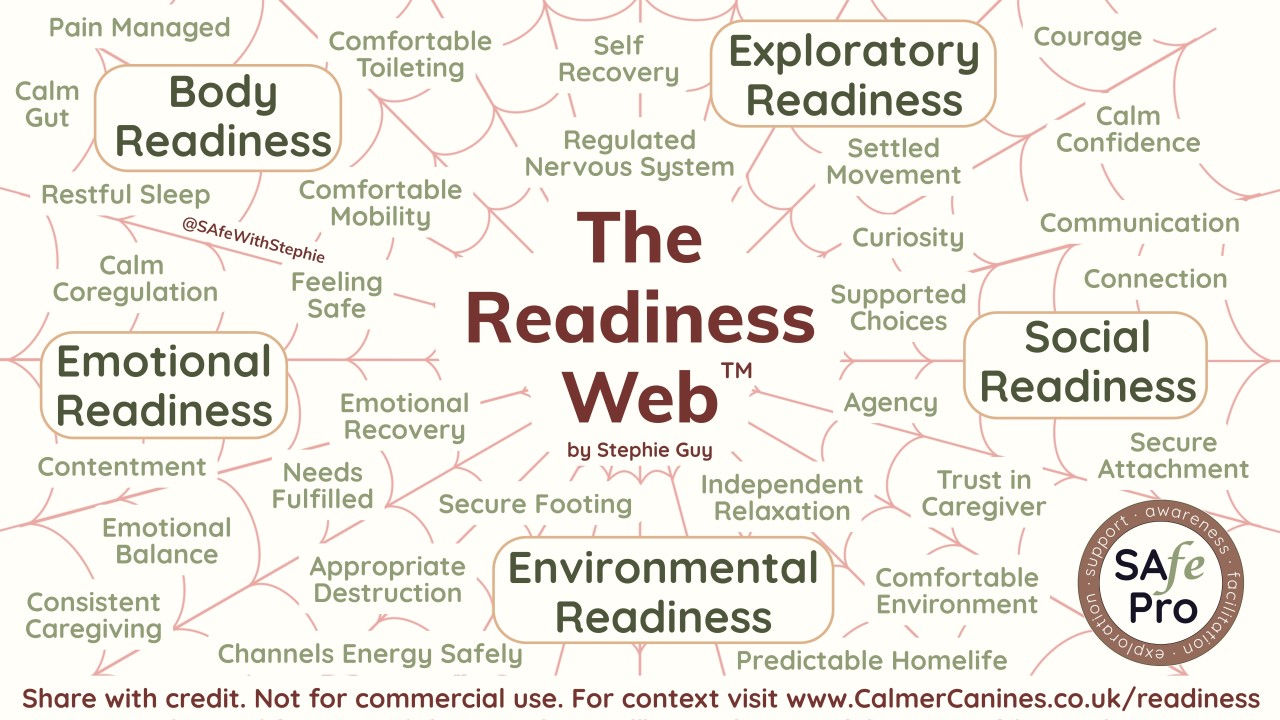
This is why Mickle’s Readiness Web matters so much. His web shows exactly which strands need softening, which need supporting and which ones guide our everyday choices.
The Pain You Cannot See
To look at Mickle walking, you would never guess how much his body is carrying. He has adapted in ways that make his discomfort almost invisible. Even his hydrotherapist, who knows him well and watches him with a trained eye, says he compensates so smoothly that the pain is barely noticeable. This is one of the challenges with dogs like Mickle. They do not always limp or flinch. They find ways to move that keep them going, even when those patterns place extra strain elsewhere.
This is why his readiness web is so important. It helps me see what the casual eye would miss. It reminds me to look beyond the surface and pay attention to the small shifts in rhythm, posture and breathing that tell the real story.
Comfort and Movement
Comfort is the first strand in Mickle’s web. It includes internal sensations, movement patterns and how he responds to anything that touches his body. Because of his hip and hock issues, he compensates heavily through his shoulders. Even a well fitting harness changes how those muscles work and how he organises his gait. That extra load becomes too much.
We have tried several styles of harness. Each one follows the same pattern. Food or excitement will carry him for the first few minutes, then once he settles, he stops moving. His body simply cannot continue under the pressure.
A simple fabric martingale collar avoids his sensitive areas. It rests lightly, spreads contact across his neck and allows him to move in the way his body currently needs.
A Note on Balance and Risk
For many dogs, a harness is the safest choice because pulling creates real risk to the neck and trachea. I am very aware of that, and it is part of my decision making. This is a balancing act. Mickle does not pull unless he is momentarily excited, and the three metre line gives him space to move without creating sudden pressure. In his case, the physical impact of a harness on his shoulders and ribcage is a greater and more consistent welfare concern than the occasional light pressure on his neck. His readiness web helps me hold that balance with care rather than assumption.
Choice and Agency
Agency is another central strand in Mickle’s readiness web. He must be able to tell me what feels safe and what does not. When I offer a harness, his body stiffens and his breathing shifts. When I offer the collar, he steps in willingly with a soft body and an open, easy posture. Respecting his agency keeps his web steady and reduces the risk of pushing him into discomfort he cannot manage.
Attunement and Co-regulation
Walking Mickle on a collar and a three metre line draws me into deeper attunement with him. He does not pull unless he is genuinely excited by something. The longer line allows me to move with him more easily so he can follow scents and respond to his environment without being held back. This protects his shoulders and lets his movement stay as natural as possible.
That extra length also gives me clearer information about his gait, rhythm and energy shifts. Small changes in tension or step length tell me how he is feeling. This helps me regulate with him and shape the walk moment by moment. His readiness web depends on this level of sensitivity because attunement keeps the whole system responsive and connected.
Emotional Safety
Emotional safety is another strand. For Mickle, safety comes from predictability, clarity and low sensory load. A harness introduces sensations that he cannot tune out. These extra sensations add to the information he is already processing from his environment and his internal discomfort.
On a collar, the world is quieter. He can think, scent, explore and settle without distraction.
Environment and Pace
Mickle’s readiness web also includes the environment we choose and the pace we set. His movement looks best when he is allowed to amble, pause and follow his nose. He needs time to organise his body. The collar and long line support this pacing because they do not require him to tolerate equipment that feels wrong.
If his body changes or if we find a different design that supports his biomechanics more comfortably, we can revisit the harness question. His web will guide us.
What Mickle’s Readiness Web Teaches Us
Mickle reminds me every day that equipment choices are never one size fits all. Behaviour work must start with the dog in front of us, not the dog in our head.
His readiness web is a living map. It shows which strands need strengthening, which need protection and which guide our decisions.
For Mickle, the fabric martingale collar is not a compromise. It is the most compassionate choice for his body, his mind and his sense of safety. It keeps his web balanced in a way that helps him step into the world with steadiness and confidence.
A Reflective Prompt
Take a moment to think about your own dog’s readiness web. Which strands feel steady at the moment, and which ones might need a closer look? You might like to notice how your dog moves, how they respond to touch or equipment, and how easily they shift between exploring and settling. What is their body telling you about what feels right for them today?
If you’d like to understand more about the Readiness Web™, and how pain, emotion, environment and connection all interlink, you can explore it further in my free masterclass replay:
👉 Watch Separation Anxiety Unpacked
Using the Readiness Web™
You’re welcome to share the Readiness Web™ graphic unaltered, as long as you include clear credit to Stephie Guy (@SAfeWithStephie) and link to the full explanation at http://www.calmercanines.co.uk/readiness. The blog adds the context and nuance needed to use the web as it was intended, so please share them together wherever possible.
The Readiness Web™ is not permitted for use in paid teaching, courses, workshops or any commercial materials. If you’d like to reference it in professional work, please direct people to the blog rather than including the graphic inside your own content.
For Caregivers
For a deeper dive into this and many other topics, come and be part of the Calmer Canines Club. It’s designed to support both caregivers and professionals with practical ideas, thoughtful discussion, and an extensive resource library.