Why SAfe doesn't build towards hours alone
 Stephie Guy

One of the questions I'm asked most often about SAfe is: how to build up to longer stretches of time home alone, often three hours or more, once everything else is in place.
It makes complete sense to ask. Most of what's been written about separation anxiety is built around increasing time, whether that's absence training or desensitisation, where a dog is left for a few seconds, then a few more, gradually stretching towards the hours a family needs. So when people meet SAfe, it's natural to look for where that step happens. The answer is that in SAfe, we don't build towards time at all.
Pieces that connect
SAfe draws on a lot of different areas. ACE Free Work, body comfort, gut health, reading body language as a whole picture, candle mapping and trauma reappraisal, supporting independence and decision making, and emotional safety beyond the home are all brought together through the Readiness Web™, guided by the SAfe Pillars of Support, Awareness, Facilitation and Exploration.
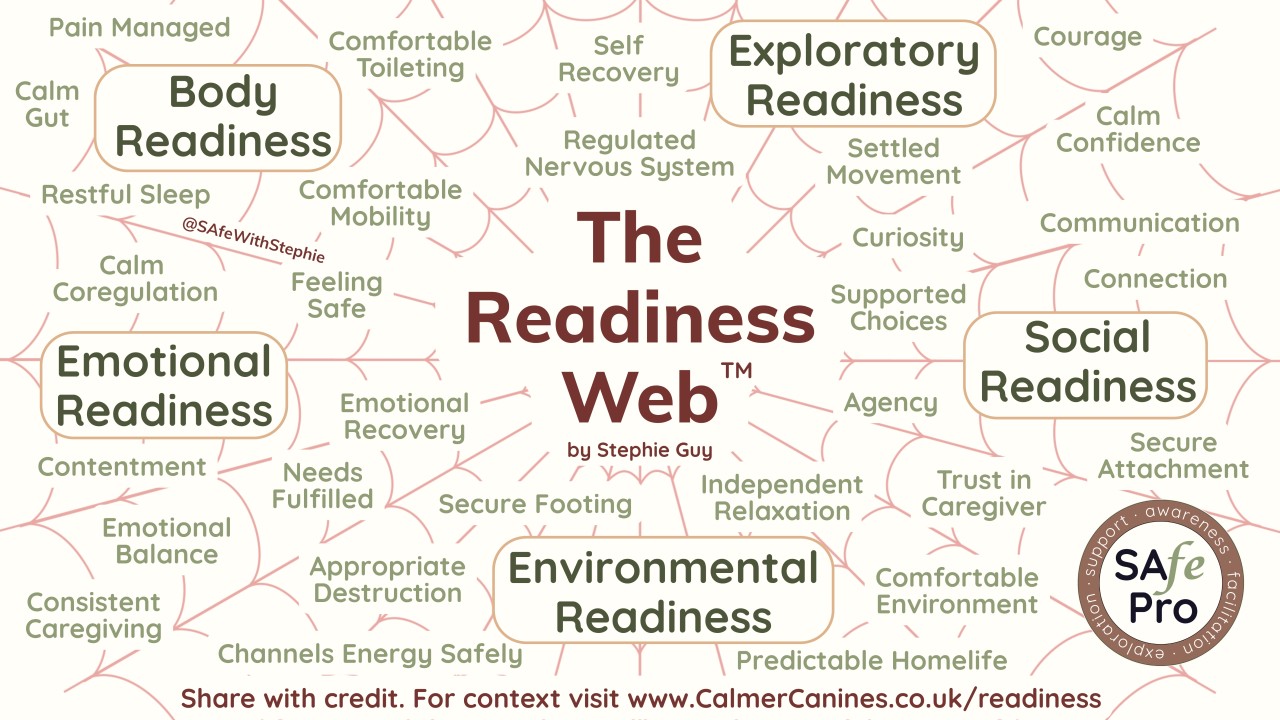
Many professionals, especially those with an ACE or TTouch background, will recognise some of these as old friends. What makes the difference is the way they connect for each individual dog. A dog with an unsettled gut, low-level discomfort, a small circle of people they trust and a home full of candles has very little room left for being alone, and supporting each strand of their web gives them that room back.
Time alone follows
As a dog's web becomes stronger across all of those areas, time alone follows naturally, so rather than asking how long a dog can manage, the question becomes how they're doing on any given day.
That shift matters because capacity changes. A dog who's comfortable for a whole afternoon one week might have less to give the next, after a busy weekend, a vet visit or a few nights of poor sleep. When we're watching the dog rather than the clock, we can meet them where they are.
Exploring departures
We do explore departures once the dog is ready. It's a quiet exploration of how they feel when we become less available, starting inside the home and widening from there, rather than a stepping stone towards longer and longer absences, which means each dog can find their own way to being comfortable at home alone.
A different question
If you're supporting a dog with separation anxiety, it can feel strange to set the hours to one side, especially when a family is relying on them. In my experience, though, time alone comes most easily when it isn't the goal. When we look after the whole dog, being home alone becomes one more part of a life that feels safe.
Stephie 🐾
Separation Anxiety & Sensitive Dog Specialist | Founder of SAfe