One step forward, two steps back: why separation anxiety progress doesn’t always hold
 Stephie Guy
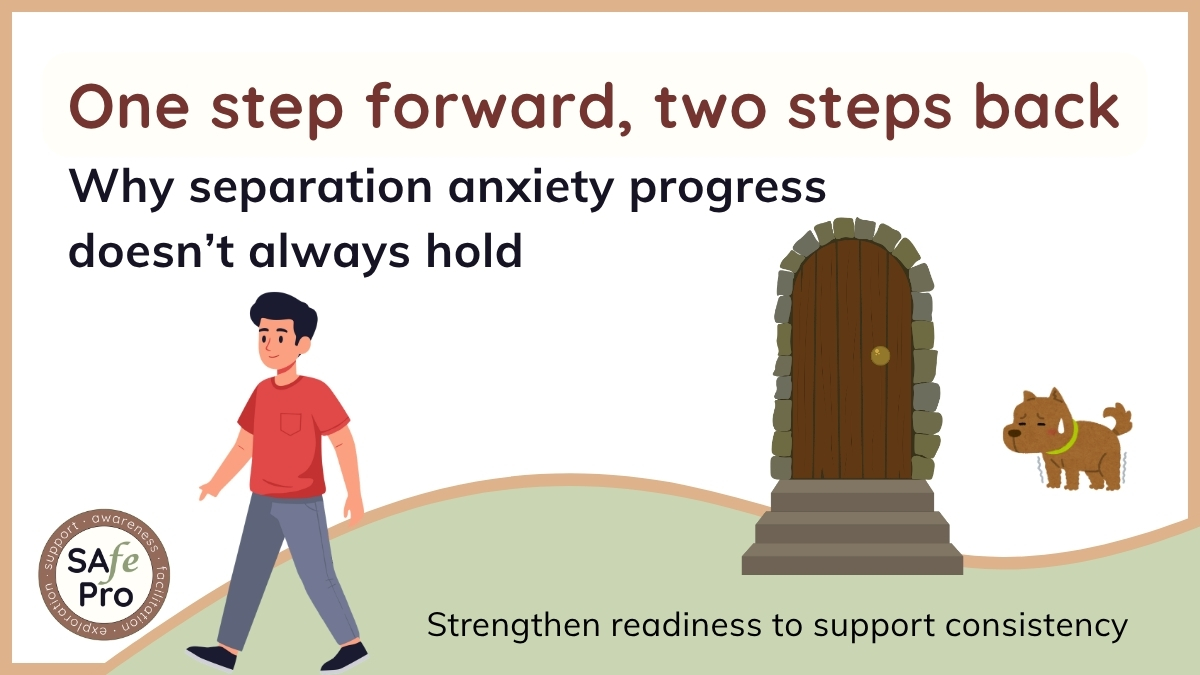
Part 3 in the SAfe Separation Anxiety Series
You’ve been paying attention, you’ve slowed things down, and you’re beginning to notice more about how your dog moves through the day. You can see the in-between moments more clearly now, the following, the watching, the way your dog stays aware of where you are. There are moments where it looks easier. Your dog settles more quickly, they don’t seem to need to track you in quite the same way, and you can move around the house without that same level of tension.
It feels like progress, and in those moments, it is. For a while it can feel like, YES! Team Dog for the win, we know what we're doing!
But then something changes. It might be a different time of day, a slightly different movement, or a small shift in what’s happening, and suddenly you’re back in that place again. The following returns, the watching returns, and it can feel as though everything has slipped.
It feels like you took one step forward and two steps back.
What's going on?
What’s important to understand here is that those moments where things felt easier were real. Your dog was settling more easily in those situations, and something had changed for them. But those changes are often happening in a context where things are more manageable overall, with less pressure, less to process, and less being asked of them. In those moments, your dog has enough capacity to take in what’s happening and respond in a different way. They don’t need to stay as alert, because the situation itself is within what they can handle. So progress holds, for that moment.
The difficulty comes when that same pattern shows up in a slightly different context. There might be a bit more going on in the environment, a bit more movement, a different time of day, or a slightly fuller load already sitting with the dog. From your point of view, it can look like the same situation. From your dog’s point of view, it isn’t. They don’t have the same capacity available in that moment, so they can’t respond in the same way. They go back to following, checking, staying alert, not because they’ve gone backwards, but because the situation has tipped beyond what they can comfortably handle.
Why it can feel like going backwards
This is what makes it feel so disheartening. You’ve seen progress, and then you see what looks like regression, and it’s very easy to assume that something has gone wrong. But what’s often happening is not a loss of progress, it’s a mismatch between what the dog can manage in one moment, and what they’re being asked to manage in another.
The progress is real, but it’s sitting within a certain level of readiness. If you’ve come across the Readiness Web™, this is where it starts to show up in real life. What your dog is carrying across their body, their emotions, their environment, and their day all shapes how much they can take in and respond to in any given moment. When the load increases beyond that, even slightly, it no longer holds.
Read more about the web here: www.CalmerCanines.co.uk/readiness
What helps progress begin to hold
When progress starts to feel more consistent, it’s usually because the dog’s readiness is changing, not just the way the situation is being handled. They have more capacity available. They can process more without becoming overwhelmed. They can stay within that more settled state across a wider range of situations.
That’s what allows progress to carry: not just repeating the same pattern, but the dog having enough in place, physically, emotionally, and environmentally, for that pattern to make sense in more than one version of the situation.
If you're experiencing set-backs, try this
Think about a moment that has felt easier recently, not the whole day, just one small piece where your dog seemed more settled.
Now step back and look at the wider picture around that moment.
👉 What else was going on that day?
👉 How much had your dog already dealt with?
👉 How much was being asked of them in that moment?
Then think about a moment where it didn’t hold.
👉 What was different in terms of what your dog was carrying, not just what you were doing?
Rather than trying to make the same pattern work everywhere, begin to explore what helps your dog have enough capacity for it to hold.
Stephie 🐾
Separation Anxiety & Sensitive Dog Specialist | Founder of SAfe
If this has got you thinking…
The next blog looks at the question that often comes next: when can you actually start leaving your dog?
→ https://www.calmercanines.co.uk/blog/when-can-i-leave-my-dog
New to this series?
Start here:
→ https://www.calmercanines.co.uk/blog/sa-isnt-about-the-door
Sharing the Readiness Web™
You’re welcome to share the Readiness Web™ graphic unaltered, as long as you include clear credit to Stephie Guy (@SAfeWithStephie) and link to the full explanation at www.calmercanines.co.uk/readiness . The blog adds the context and nuance needed to use the web as it was intended, so please share them together.
For Caregivers
For a deeper dive into this and many other topics, come and be part of the Calmer Canines Club. It’s designed to support both caregivers and professionals with practical ideas, thoughtful discussion, and an extensive resource library.
For Professionals
If you’re a trainer or behaviour professional working with families affected by separation anxiety, the SAfe Pro Course will help you go beyond stopwatch desensitisation and towards true readiness-based support.
You’ll learn to integrate the Readiness Web™, ACE Free Work, and trauma-informed practice into your client work, giving both dogs and caregivers space to rebuild safety, confidence, and trust.
The Shouty-Barky Dog Group
The Shouty-Barky Dog Group is a warm, trauma-informed space for people living or working with anxious and sensitive dogs. Through Stephie’s thoughtful questions, we explore varied themes in depth, giving you time to reflect, discover, and draw your own conclusions without pressure, judgment, or unsolicited advice.