When It Feels Like Nothing Is Working
 Stephie Guy
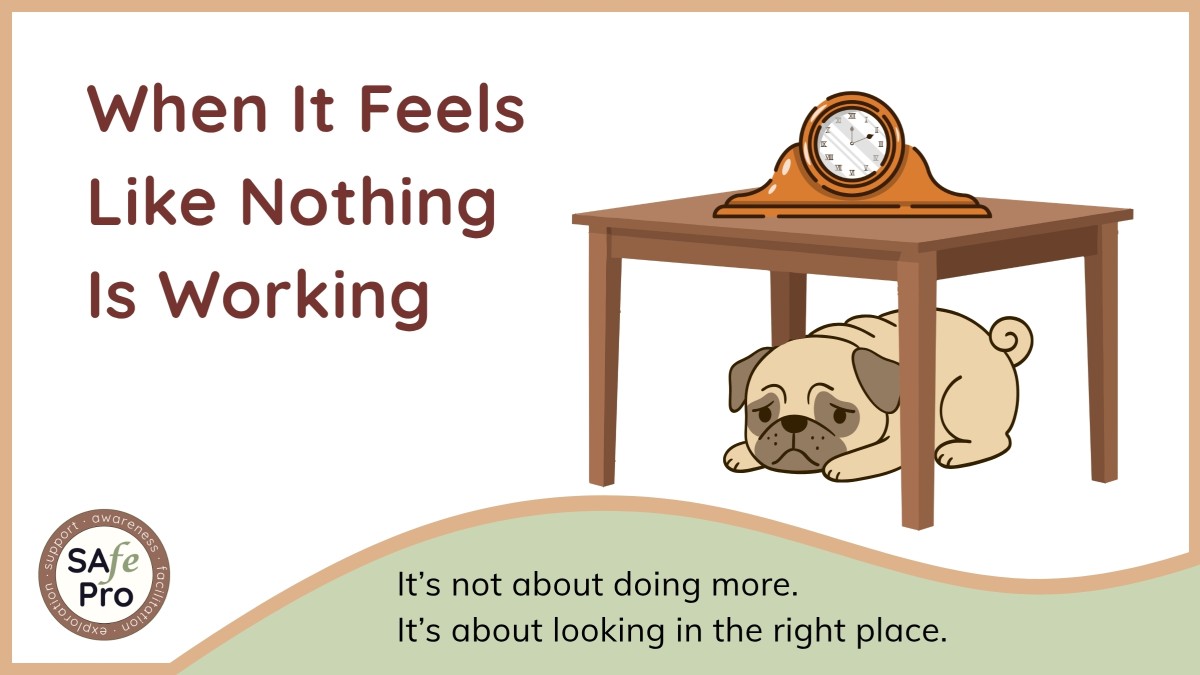
Part 9 in the SAfe Separation Anxiety Series
This is a place many people reach at some point, whether you're living with your own dog or supporting someone else’s.
You've been putting the time in, you've been thinking things through. You've tried different approaches, adjusted routines, noticed small details, and paid close attention to what is happening in front of you. And still, it can feel like nothing is ever going to work.
There might be moments that look promising, where things seem a little easier, a little calmer, a little more settled. But those improvements don't always hold, and the next day it's back to disappointment again. It can leave you, or the people you are supporting, wondering what's being missed.
When effort doesn’t seem to match the outcome
One of the hardest parts of this experience is the sense that a lot is being done, but it's not clearly reflected in the outcome.
You, or your client, might be:
👉 trying to keep things predictable
👉 thinking carefully about movement around the dog
👉 adjusting routines to reduce pressure
👉 giving the dog space to settle
👉 paying close attention to responses and patterns
All of that matters. But if the change you are looking for is not showing up clearly, it can feel as though it is not enough.
For professionals, this can also bring an added layer. You may be reviewing plans, questioning your decisions, or wondering whether you need to change direction, when in reality something else may be going on underneath.
Working at the level of the moment
When things feel stuck, it's easy to assume that more needs to be added. More structure. More consistency. More repetition. More focus on getting the leaving right. Perhaps trying to shape or influence what happens as the person steps out of sight. This often comes from a very understandable place, wanting to help, wanting things to go well, wanting to avoid distress.
But often, the difficulty is not about how much is being done, it's about where the focus is being directed. If most of the effort is going into the moment itself, then the layers underneath that moment can stay relatively unchanged. And if those layers are unchanged, the outcome will often follow a similar pattern, even if the surface looks a little different each time.
These moments matter, they're part of the picture. But they're not separate from everything the dog has already experienced that day. They sit on top of it, and if the focus stays mainly on the moment, those adjustments are only being made to one layer of a much bigger system.
What changes when you widen the view
When the focus shifts to what the dog is carrying into those moments, a different kind of information starts to appear.
You might begin to notice:
👉 how easily the dog settles earlier in the day
👉 how much movement or interruption has already happened
👉 how the dog’s body looks and feels in ordinary moments
👉 how predictable things have been
👉 how the dog responds to small changes in the environment
For caregivers and professionals alike, a fuller picture starts to emerge, and with it, new directions become possible.
These layers are not separate from what happens when the person becomes unavailable; they shape it. And when those layers begin to change, the moments that have been the main focus often start to look different without needing to be directly altered.
Why it doesn’t always feel obvious
This kind of change can be harder to spot at first. It doesn't always show up as a clear, measurable departure win. It might look like a slightly longer period of relaxed settling, a softer body when someone moves around, less urgency in following from room to room, more choice in where the dog spends time.
On their own, these can seem small, but together, they begin to change what the dog is bringing into those moments that have felt most difficult.
What this means for you
If it has been feeling like nothing is working, it doesn't mean you, or your client, have been doing it wrong. It simply means the effort has been concentrated on a place that does not yet connect fully with what is driving the dog’s experience.
Sometimes all it takes is looking in a slightly different direction. And when something new comes into focus, it opens up options that weren't there before.
Try This
Take one moment that has been feeling difficult and imagine you couldn’t work on that moment directly at all.
👉 If that piece was off the table, where would your attention go instead?
You might find yourself looking earlier in the day, at how easily your dog rests, how predictable things feel, or how much they need to keep track of you.
This isn’t about ignoring the difficult moment, it’s about noticing what else might be shaping it. And if you notice something, even something small, that's worth sitting with.
Where this leads
If this has got you thinking about where you've been putting your attention, the next step is seeing what it looks like to shift it.
In my free webinar, Separation Anxiety Unpacked, I walk through how the SAfe approach works in practice, from noticing what your dog is carrying into each moment, to understanding what that means for where you focus next.
👉 You can join here: www.heartdogtrainers.com/separation-anxiety-unpacked-masterclass-registration
Because when the picture starts to widen, the places worth working on become a lot clearer. And that's when things can begin to move.
Stephie 🐾
Separation Anxiety & Sensitive Dog Specialist | Founder of SAfe
Up next...
The next blog shifts from understanding what’s happening to looking at what actually allows things to change.
→ [COMING SOON]
New to this series?
Start here:
→ www.calmercanines.co.uk/blog/sa-isnt-about-the-door