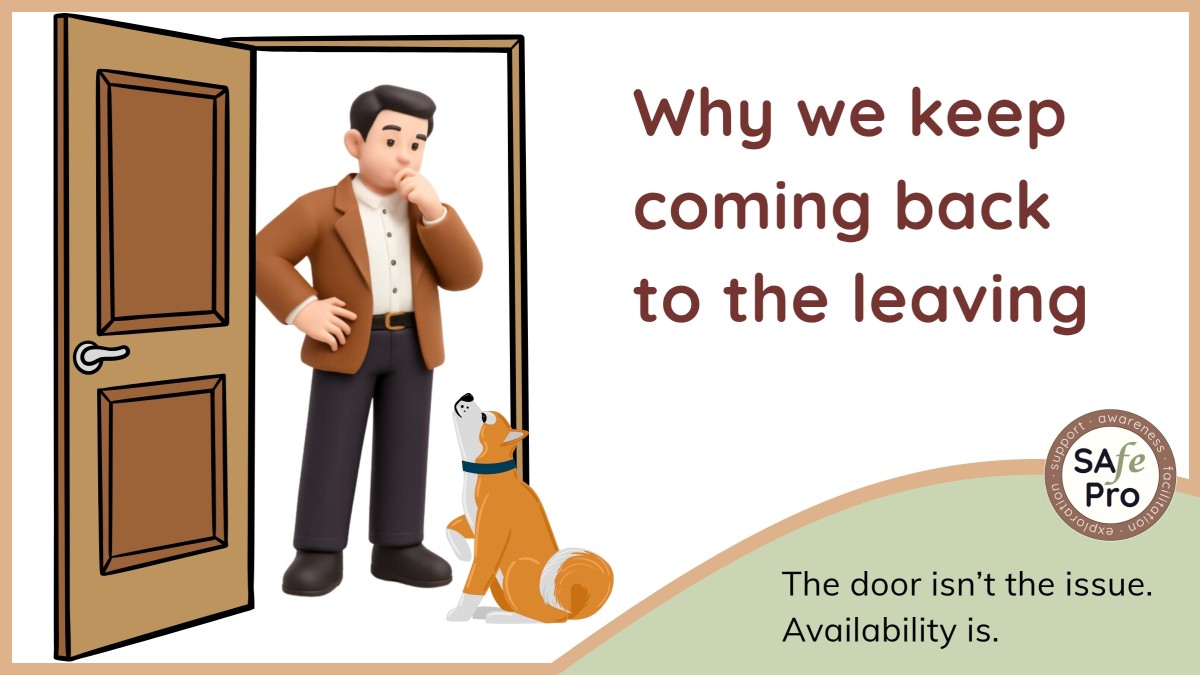
Why we keep coming back to the leaving
 Stephie Guy
Part 8 in the SAfe Separation Anxiety Series
When you're living or working with a dog who struggles when you are unavailable, it makes complete sense that your attention keeps returning to the leaving itself.
The leaving is the moment that feels most obvious. It is the point where everything seems to happen. It is the part other people notice. It is the bit you get asked about. How long were you gone? What did you do before you left? Did you pick up your keys? Did you get to the door?
So of course many people end up watching the leaving closely, thinking about the leaving constantly, and measuring progress around the leaving.
It is the moment with the clearest edges, which makes it feel like the place where the answer must be.
Why the leaving draws us in
The leaving is easy to point to. It has a beginning. It has an ending. It feels measurable. You can say, “I walked to the door.” You can say, “I stepped outside.” You can say, “I was gone for ten seconds.”, and that kind of clarity can feel reassuring when everything else feels harder to pin down.
By comparison, the rest of the picture can feel much less tidy.
How rested was your dog that day? How much had already happened in the house? How easy was it for them to settle after breakfast? Did they seem comfortable in their body? Were they already carrying more before you even stood up?
Those questions matter deeply, but they are not always as easy to measure. They ask for observation rather than a stopwatch. They ask you to widen the lens.
The problem with making the leaving the centre of everything
When the leaving becomes the main thing we focus on, it is easy to miss the conditions surrounding it. Two departures may look almost identical on paper. The same room, the same person, the same route to the door, the same number of seconds away. And yet the dog experiencing those departures may not be starting from the same place at all.
On one day, they may have had enough sleep, more room to move, fewer interruptions, less social pressure, and a body that feels easier to be in.
On another day, they may already be carrying tension, physical discomfort, uncertainty, or the weight of a busy morning.
If we only study the leaving, those two moments can look as though they should have the same outcome, and when they don't, it can feel confusing or disheartening. But often the confusion begins when we treat the leaving as a separate event instead of part of a bigger picture.
Why people keep being pulled back there anyway
There is also a very human reason we keep circling back to the leaving: it's the part that feels urgent.
People need to go out. They need to work, collect children, answer the door, attend appointments, and live their lives. The leaving can feel like the obstacle sitting in the middle of everyday life, so it naturally becomes the thing everyone wants solved first.
It can also feel emotionally loaded. The moment of leaving may bring dread, guilt, hope, pressure, or a strong wish for signs that things are improving. That emotional weight can make the leaving feel even more important.
So when people keep coming back to it, it's not because they are getting it wrong. It's usually because they're trying to find something concrete in a situation that feels stressful and uncertain.
What becomes possible when we widen the frame
Once you begin to see the leaving as one moment within a wider system, the picture often starts to make more sense. You might notice that the dog who seemed “fine with a short absence” was actually working quite hard to stay organised, or that difficulty did not begin when you touched the door handle, but much earlier in the day.
You might notice that some forms of support make more difference than changing the departure itself, or that what looked inconsistent was not random at all.
This is one reason the leaving cannot be the only thing we study. It matters, of course. It's part of the story. But it doesn't tell the whole story on its own.
Coming back to the leaving in a different way
Now, there's nothing wrong with looking at the leaving. The shift is in how we look at it.
👉 Instead of asking only, “What happened when I left?” we can also ask, “What was in place before that moment?”
👉 Instead of asking only, “How long did my dog stay settled?” we can ask, “What did settling actually look like in their body?”
👉 Instead of asking only, “Why did this go better yesterday?” we can ask, “What was my dog carrying on each day?”
These questions don't take you away from the leaving. They place it in context, and that context is where the useful information lives.
This is why we keep returning to the bigger picture
When I keep bringing things back to daily life, readiness, physical comfort, pressure, predictability, movement, and rest, it's not because the leaving does not matter. It's because the leaving matters too much to look at in isolation.
If we want to understand what is happening for the dog, we need to understand the state they are in when that moment arrives.
That's why we keep coming back to the wider picture.
That's why we keep asking what the dog is carrying into the moment.
And that's why the leaving, important as it is, is rarely the only place we need to look.
Try This
Instead of waiting until you are about to leave, choose a time when nothing much is happening.
👉 Watch what your dog does in the moments where you might usually begin to move towards the door, picking things up, changing rooms, or getting ready to go out.
👉 Notice how they respond to those small shifts. Do they stay where they are, follow, pause, or begin to watch more closely?
You’re not building up to a leaving here, and you’re not testing anything. You’re simply noticing what happens in the earlier moments, before the door is even part of the picture.
Stephie 🐾
Separation Anxiety & Sensitive Dog Specialist | Founder of SAfe
If this has got you thinking…
The next blog looks at why it can feel like nothing is working, even when you’re doing a lot, and what might be sitting underneath that.
→ [COMING SOON]
New to this series?
Start here:
→ www.calmercanines.co.uk/blog/sa-isnt-about-the-door