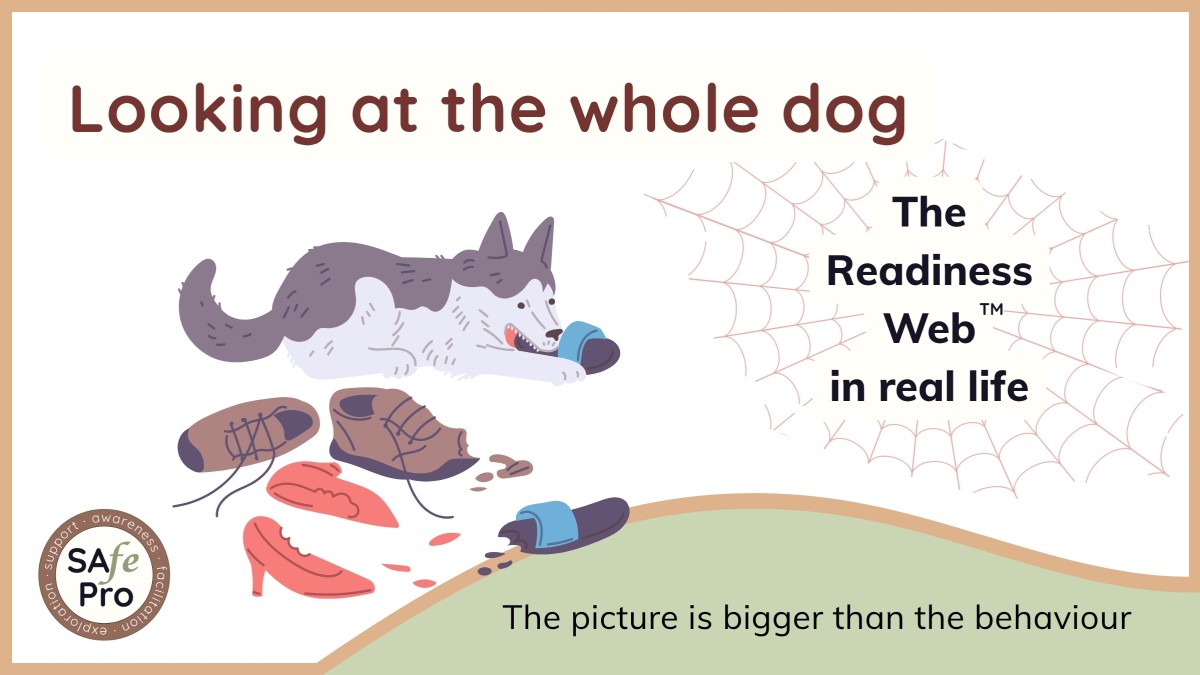
Looking at the whole dog: The Readiness Web™ in real life
 Stephie Guy
Part 7 in the SAfe Separation Anxiety Series
As we’ve moved through this series, everything keeps circling back to the same place, and it's not the door; it's not the leaving; and it's not even one behaviour on its own; but what your dog is carrying emotionally into each moment.
We’ve looked at how things can feel super steady one day and then really not great the next. We've looked at how following can show up in different ways, and how the same behaviour can come from very different places.
It begins to feel less like separate pieces, and more like one picture.
One picture, not separate pieces
You know, it’s very natural to focus on what we can see: the following, the settling, the vocalising, the staying close, the moving away, and so on. And that's because these are the parts that stand out, the parts we can describe, the parts that feel like something we can work on.
But as you watch more closely, you start to notice that those behaviours don’t happen on their own, and they don't always show up in exactly the same way. They change. Sometimes subtly, sometimes quite quickly, even when the situation looks the same.
Looking at one behaviour at a time can only take you so far, because what you’re seeing is the result of everything that’s already in place.
What The Readiness Web™ helps you see
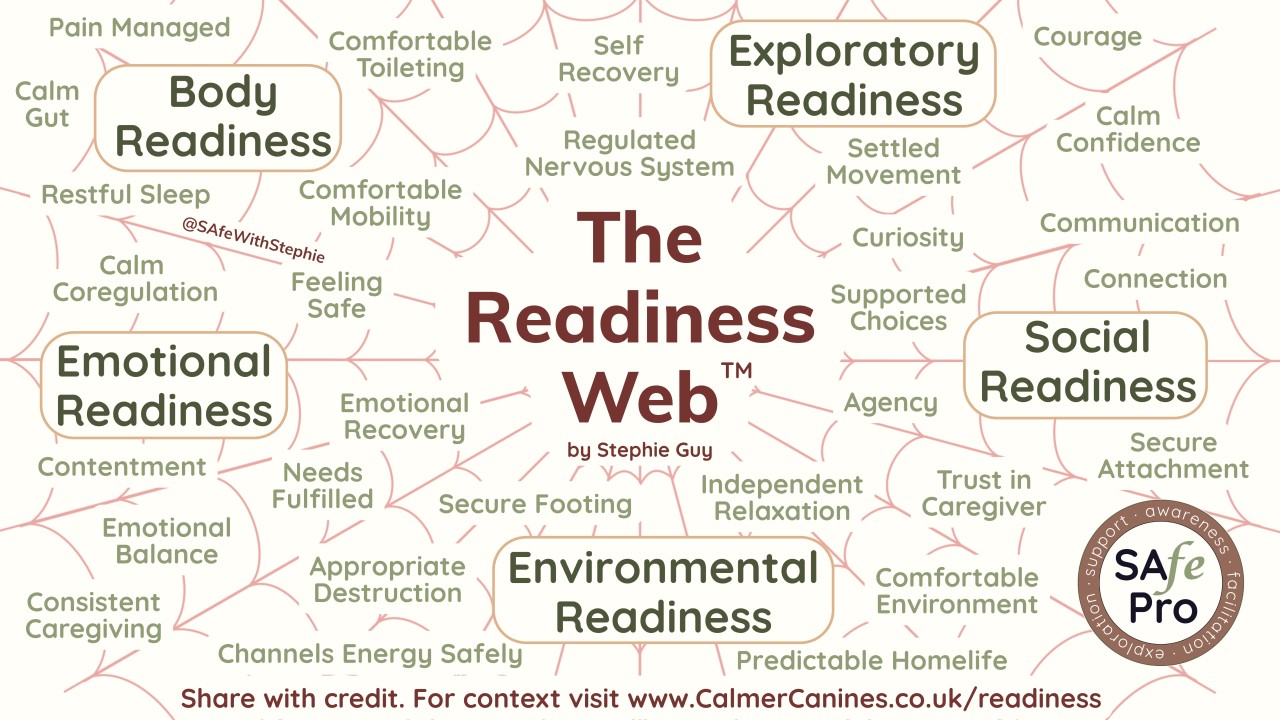
This is where the Readiness Web™ becomes useful, as a way of holding the whole picture at once. It brings together five areas that are always interacting.
👉 Body Readiness, how comfortable it feels to move, to rest, and to stay in one place.
👉 Emotional Readiness, what they’re processing and what they’re holding onto from earlier moments.
👉 Environmental Readiness, what feels easy or difficult around them, and what’s being asked of them in that space.
👉 Social Readiness, how they are positioned in relation to you or others, and how predictable your movement and availability feel from their point of view.
👉 Exploratory Readiness, how easily they can move, explore, make choices, and recover without needing support from you.
All of these are constantly influencing each other. When something shifts in one part of the web, the rest of the web responds.
Why the same moment can feel different
On the surface, that one behaviour can look like it's the same from one moment to the next. It's the same dog, in the same home, with the same person.
But the day is different.
👉 There may have been more movement in the house.
👉 The environment may feel busier.
👉 Their body may feel different.
👉 There may have been less opportunity to rest.
So whilst what you see on the surface can look the same, what is changing is what the dog is carrying into that moment.
Why this changes how you move forward
When you begin to see behaviour as part of the web, the questions you ask start to shift. So "How do I stop this?" and "How do I get them used to it?" gives way to
👉 What’s in place for my dog right now?
👉 What are they carrying into this moment?
👉 Where might the pressure be sitting?
This way of looking brings your attention to the conditions surrounding the behaviour. As those conditions begin to feel more workable for your dog, behaviour starts to move with them.
Try this
Think about one ordinary moment from your dog’s day, not the most difficult one, just something everyday.
Now look at it from a few different angles.
👉 What does your dog’s body look like in that moment, how easy it seems for them to move or settle.
👉 What their emotional state might be, whether they appear relaxed, alert, or holding a bit more.
👉 What the environment is like around them, how busy, quiet, or easy that space feels.
👉 What the social picture looks like, how they are positioned in relation to you or others, and how much they seem to be keeping track.
👉 And what opportunities they have to explore, move, or make choices in that moment.
You’re not trying to analyse it deeply or get it right. You’re simply beginning to look at one moment through a wider lens, rather than from a single angle.
Stephie 🐾
Separation Anxiety & Sensitive Dog Specialist | Founder of SAfe
If this has got you thinking…
The next blog looks at why we keep coming back to the leaving itself, and how focusing there can pull attention away from the bigger picture.
→ https://www.calmercanines.co.uk/blog/why-we-keep-coming-back-to-leaving
New to this series?
Start here:
→ https://www.calmercanines.co.uk/blog/sa-isnt-about-the-door