Following isn't just one thing
 Stephie Guy
Part 6 in the SAfe Separation Anxiety Series
Following can look simple, but it rarely is. The same behaviour can come from different places, and understanding that changes everything.
By now, you might be looking at following a little differently
In the last few blogs, we’ve been stepping back from the obvious moments, not just the door, but what’s happening inside the home, how your dog experiences your movement, and why things can feel wonderful one day and then terrible the next.
We’ve looked at how progress doesn’t always hold in the way we expect, and how leaving isn’t really a step you move on to, but something that reflects what your dog is already bringing into that moment.
So when you come back to something like following, it starts to feel less like a simple habit, and more like part of a bigger picture. You begin to notice the pattern, the way it changes with your movement, the way it shows up more in some moments than others, and that’s where it starts to get really interesting, because following isn’t always about the velcro dog.
What about dogs that don't follow?
When we use the word “following”, it doesn’t always mean getting up and moving after you. Some dogs show this much more quietly, or in ways that don’t look like following at all. This is just one piece of the picture.
👉 Sometimes it’s in the eyes, the way your dog tracks where you are
👉 Sometimes it’s in the ears, listening for what you’re doing in another room
👉 Sometimes it’s in the body, staying poised, waiting for what might happen next
So we’re not just looking at movement here, we’re looking at how your dog stays connected to you.
The same behaviour can come from different places
Two dogs can look exactly the same on the surface, both following their person from room to room, both appearing in the doorway, both repositioning as the person moves, and yet what’s underneath that can be very different.
One dog might be keeping track because your movement doesn’t feel easy to follow. Another might be moving because settling comfortably isn’t straightforward for them in that space. Another might be responding to the environment, the layout, the surfaces, the options they have available to rest. And another might simply not have found a place that feels easy enough to switch off.
From the outside, it all looks like “following”, but the experience underneath it isn’t the same.
Why that matters more than the behaviour itself
When you start to see that following can come from different places, it changes how you respond to it. If two dogs are doing the same thing on the surface, but for different reasons, then responding to the behaviour alone is unlikely to land in the same way for both of them.
It's very easy to focus on the visible part, creating distance, encouraging the dog to stay put, trying to reduce the following itself, and sometimes that can appear to work for a moment, but if the reason for the following sits somewhere else, nothing really settles in a lasting way.
The behaviour isn’t the starting point, it’s the result of everything that’s already in place.
Looking beyond the behaviour
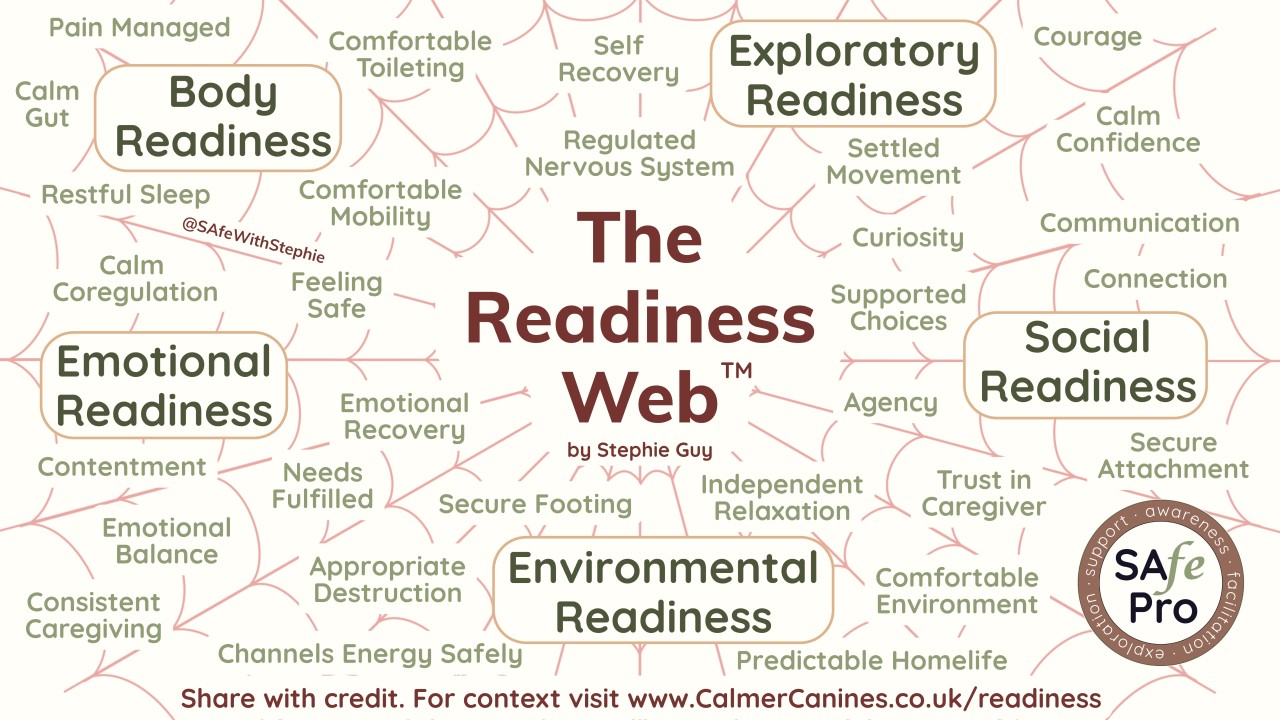
The behaviour sits within everything your dog is carrying in that moment, their body and how comfortable it feels to move or rest, their environment and what feels easy or awkward within it, their emotional state and what they’re processing, and your movement, how predictable and understandable that feels from their point of view.
All of those pieces are interacting all the time, so what you see on the surface will shift as those pieces shift, even if nothing obvious has changed. And this is often where things start to feel confusing, because from the outside, it can look like the same situation, the same movement, the same house, the same dog.
But from the dog’s point of view, it isn’t the same moment.
Why it changes, even when it looks the same
There will be times where your dog follows with their body, their eyes or their ears and then settles again quite easily, where there’s a bit more space, a bit less need to keep track, and everything feels more settled.
And then there will be times where that same pattern feels more intense, where your dog stays close, keeps watching, doesn’t quite switch off in the same way. It can feel inconsistent, as though something has changed or gone backwards. But often what’s shifting isn’t the behaviour itself, it’s what your dog is bringing into that moment.
👉 The time of day
👉 What’s already happened
👉 What their body feels like
👉 What the environment is asking of them
And as those things change, the behaviour moves with them.
Where the Readiness Web™ comes into view
This is one of the many moments where the Readiness Web™ is useful, as a way of making sense of what you’re seeing. It gives you a way of holding all of these pieces together, rather than trying to isolate one behaviour and fix it.
Following isn’t separate from the rest of your dog’s experience. It sits within it, shaped by everything your dog is carrying across their body, their environment, their emotions, and their relationship with you.
And as those pieces shift, even slightly, what you see on the surface shifts with them.
A different place to stand
So instead of asking “how do I stop my dog following me?”, you might find yourself asking something slightly different.
👉 What might be sitting underneath this?
👉 What is my dog bringing into this moment?
👉 And how does that change across the day?
Because when you start to look at it this way, following stops being something you need to fix, and becomes something you can understand, and that changes what you do next.
Try this
Think about two moments where your dog has followed you recently. One where it felt quite easy, where they followed and then settled again without much fuss. And one where it felt more intense, where they stayed close, kept watching, or didn’t seem able to switch off in the same way.
Place those two moments side by side and just sit with them for a moment.
What was different? Not just in what you were doing, but in what your dog might have been carrying at the time.
👉 What was happening in their body, how comfortable and easy it was to move or settle
👉 What their emotional state felt like, how much they were already holding or processing
👉 What the environment was asking of them, the space, the surfaces, the level of activity
👉 What their day had already looked like, what had built up before that moment
👉 How clear and predictable your movement felt to them
You’re not looking for a single answer here, just beginning to notice the pattern that sits underneath the behaviour.
Because once you can see what’s influencing it, you’re no longer working from the surface, and that’s where things begin to shift.
Stephie 🐾
Separation Anxiety Specialist | Founder of SAfe
If this has got you thinking…
The next blog zooms out to look at the whole picture, and how everything your dog is carrying comes together in each moment.
→ COMING SOON
New to this series?
Start here:
→ https://www.calmercanines.co.uk/blog/sa-isnt-about-the-door